Most D&D backstories end up in a drawer. Not because they're bad, but because there's nothing in them a DM can use. A tragic past is fine, but if everyone involved is dead and the problem is solved, the backstory is finished before the campaign starts.
The backstories that come up again and again at the table have one thing in common: something from the past is still unresolved. A debt, a rival, a secret, a promise. That loose thread is what your DM pulls on.
Below are 40 D&D backstory ideas, sorted by class and by background. Each comes with a hook: the unresolved piece your DM can turn into a scene, an NPC or a whole arc. Use them as written or mash two together.
If you want a full backstory written around your character's race, class and background, the Backstory Generator builds one with personality traits, an ideal, a bond and a flaw for D&D 5e, Pathfinder 2e or Daggerheart. There's a real example further down.
 MythScribe's Character Backstory Generator page, built for D&D 5e, Pathfinder 2e and Daggerheart
What Makes a Good D&D Backstory?
A useful backstory answers four questions, and none of them need more than a sentence:
- Where are you from? A place the DM can put on the map.
- Who do you care about? At least one living person who can show up later.
- What do you want? A goal that adventuring helps with.
- What's unfinished? The hook. The thing that could walk through the tavern door in session five.
Keep it short. Half a page is plenty. Your DM has five of these to read, and the parts that matter will come out in play anyway.
Backstory Ideas by Class
Fighter
- The Champion's Shadow. You were the body double for a famous knight. The knight died, and their family wants you to keep pretending. Hook: someone who knew the real knight is getting suspicious.
- The Deserter. You walked off a battlefield because the order was wrong. Hook: your old sergeant is now a captain, and she's hiring.
- Pit Fighter. You fought in an underground arena to pay your family's debt. You won the final bout by accident. Hook: the fighter you beat wants a rematch, and the arena owner says the debt isn't paid.
Wizard
- The Dropout. You were expelled from a magic academy for reading a forbidden book. You remember every word. Hook: the academy wants the knowledge back, one way or another.
- The Apprentice Who Outlived Their Master. Your mentor died mid-experiment. Their spellbook is half finished. Hook: the missing half is in the hands of their rival.
- The Copyist. You transcribed spellbooks for rich wizards and secretly kept copies. Hook: one of the books you copied was cursed.
Rogue
- The Honest Thief. You only steal from people who deserve it. One of your marks was innocent. Hook: they've been ruined, and they know your face.
- The Inside Man. You spent four years as a servant in a noble house, planning one heist. You never did it. Hook: your old crew thinks you sold them out.
- The Forger. You forged a document that started a war. Nobody knows it was you. Hook: someone has started looking.
Cleric
- The Doubter. You took vows to escape a bad home, not out of faith. Your god answers you anyway. Hook: you don't know why, and neither does your temple.
- The Last Priest. Your temple was destroyed. You're the only one left who knows the rites. Hook: the people who burned it believe they finished the job.
- The Healer Who Failed. You couldn't save someone important. Their family blames you. Hook: the family is powerful and holds grudges.
Paladin
- The Broken Oath. You broke your oath once. You've never told anyone what happened. Hook: the person you failed is still alive.
- The Successor. You inherited your oath from a dying paladin you met on the road. Hook: their order doesn't know you exist and won't be pleased.
Ranger
- The Guide. You led a group of settlers into the wilderness. Not all of them came back. Hook: the survivors have built a town, and they never mention the ones who were lost.
- The Hunter of One Beast. You've been tracking the same creature for ten years. Hook: lately, it's been tracking you.
Bard
- The Song That Got Away. You wrote a satirical song about a noble. It became famous. Hook: the noble now has a bounty out on the songwriter, and doesn't know it's you.
- The Archivist of Gossip. You collect secrets in verse. Hook: one of your songs contains a secret you didn't realize was true.
Warlock
- The Bargain You Didn't Read. You signed a pact while dying. You haven't read the fine print. Hook: your patron has started making requests.
- Inherited Pact. Your patron's deal was with your grandmother. She died before paying. Hook: the debt passed to you.
Sorcerer
- The Accident. Your magic first appeared during a disaster you may have caused. Hook: survivors of that day are still looking for whoever did it.
- Bloodline Secret. Your family hides its magic for a reason. Hook: you've just learned the reason, and it's hunting your relatives.
Druid, Monk and Barbarian
- Druid: The Circle's Exile. Your circle cast you out for protecting a town they wanted to reclaim for the wild. Hook: the circle has decided to try again.
- Monk: The Unfinished Lesson. Your master left mid-sentence one morning and never returned. Hook: you've just heard the end of the sentence from a stranger.
- Barbarian: The Last of the Clan. Your clan's lands were taken by a neighboring lord. Hook: the lord has offered you a job.
Backstory Ideas by Background
The 2024 D&D System Reference Document (SRD 5.2.1) includes four backgrounds: Acolyte, Criminal, Sage and Soldier. Each gives ability score increases, an Origin feat, two skills, a tool proficiency and starting equipment. The rules don't give you a story, so here are hooks that fit each one.
Acolyte
- The Keeper of the Reliquary. You guarded a holy relic for years. It was swapped for a fake on your watch. Hook: only you know it's fake.
- The Translator. You copied prayers in a language nobody else in your temple could read. Hook: the prayers aren't prayers.
Criminal
- The Fall Guy. You took the blame for your crew's job and served time. Hook: the crew got rich while you were inside.
- The Fence. You moved stolen goods for every gang in the city. Hook: you know where everything went, which makes you very valuable to a lot of people.
Sage
- The Lost Library. You catalogued a library that burned down. You're the only index left. Hook: someone is rebuilding the collection by stealing from other libraries.
- The Wrong Answer. Your research proved a famous historian wrong. They're still very famous. Hook: they've been quietly ruining your reputation.
Soldier
- The Gate Guard. You held a gate during a siege and opened it to let refugees in. The enemy came in with them. Hook: some say you were a hero, others a traitor.
- The Quartermaster. You managed supplies for a company that disbanded. Some of the supplies never got returned. Hook: the crown is auditing.
Other Backgrounds
Many tables use backgrounds from other sourcebooks or homebrew. A few hooks that work with most:
- Noble: You are fifth in line for a title. Four people ahead of you have died this year.
- Sailor: Your ship sank and you were the only survivor. Your old captain was just seen alive in a port city.
- Hermit: You went into isolation to escape something. You've just learned it's still waiting.
- Entertainer: You were the star of a traveling troupe until the troupe left you behind in the middle of the night.
- Guild Artisan: You made a lock that nobody could break. Someone just broke it.
- Outlander: You came to civilization to deliver a warning. Nobody believed you.
- Urchin: You grew up on the streets with three friends. One became a priest, one a guard captain, one a crime boss.
A 5-Question Backstory Template
If you're stuck, answer these five questions in a sentence each. That's a complete backstory.
- Where did you grow up, and who raised you?
- What event made you leave home?
- Who from your past is still alive, and how do they feel about you?
- What do you want that adventuring could help you get?
- What secret are you keeping from the rest of the party?
Hand the answers to your DM. Question 3 and question 5 are the ones they'll use.
The Backstory Generator uses a similar structure. Pick your system, race (or ancestry), class and background, and it writes a narrative plus personality traits, an ideal, a bond and a flaw. You can edit any of it before you save it.
Example: a D&D 5e backstory generated with MythScribe
We picked D&D 5e, Tiefling, Warlock, Criminal background. The personality block came back as:
Ideal: Greed. I will do whatever it takes to become wealthy. Bond: My ill-gotten gains go to support my family. Flaw: If there's a plan, I'll forget it. If I don't forget it, I'll ignore it.
The backstory followed a street kid named Elara, cornered by a rival gang at fourteen, who cried out "not to any god, but to something else" and got an answer. It ends on an open question: "Is she truly in control, or is she merely a pawn in a cosmic game?" That's idea 19 from the list above, The Bargain You Didn't Read, with a hook your DM can pull on.
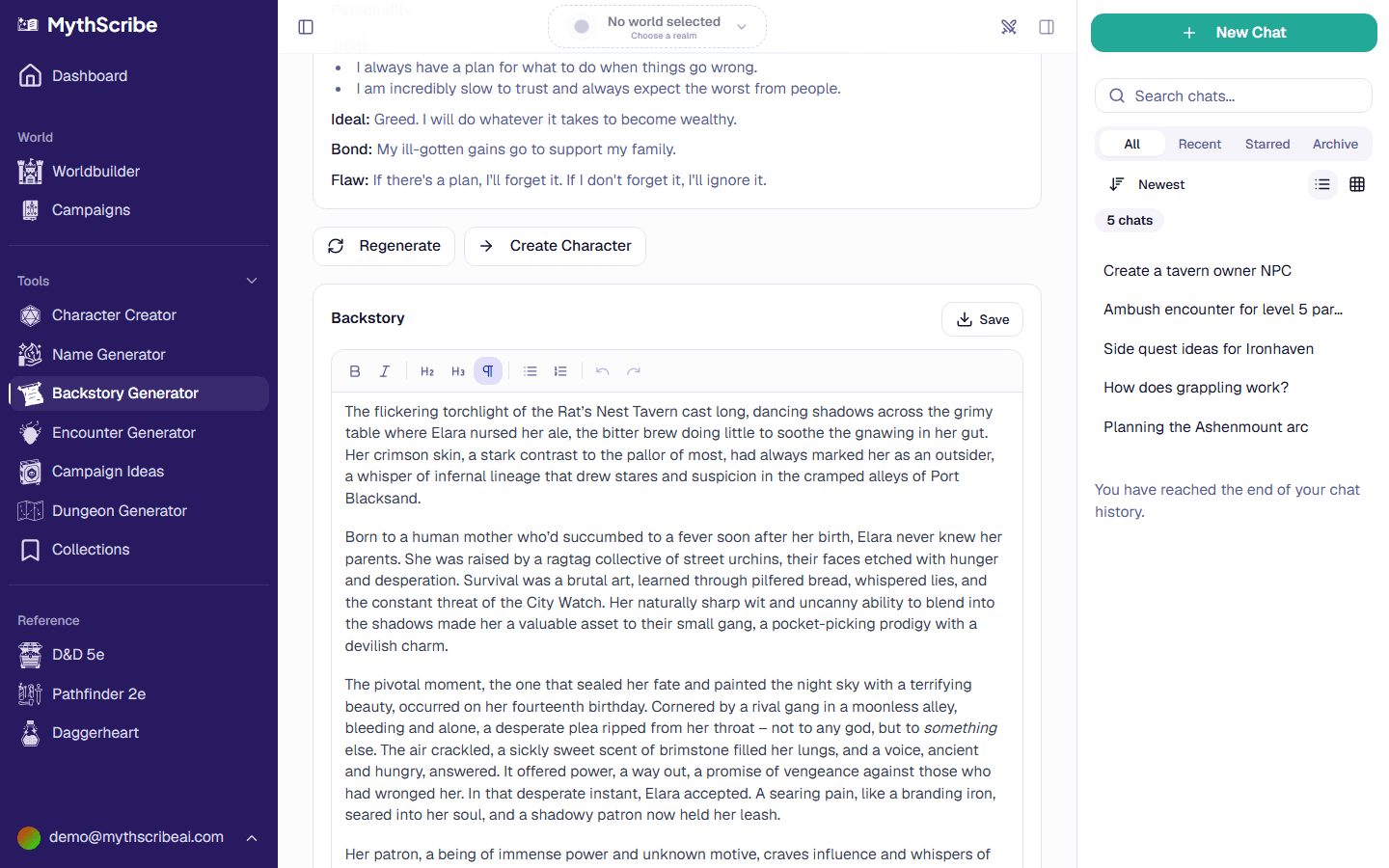 MythScribe Backstory Generator result for a Tiefling Warlock with the Criminal background: ideal, bond, flaw and a pact backstory
Backstories for Daggerheart and Pathfinder 2e
Daggerheart
Daggerheart builds backstory into character creation. Each class in the SRD comes with background questions to answer about your own past and connection questions to ask another player, so the party's relationships are set before session one. For example, the Rogue's background questions include who from your past is still chasing you.
Your community is also a backstory prompt. The SRD has nine (Highborne, Loreborne, Orderborne, Ridgeborne, Seaborne, Slyborne, Underborne, Wanderborne and Wildborne). A Slyborne character comes from a group operating outside the law with its own strict code of honor, which suggests a backstory hook straight away: what did you do when that code was broken?
If you'd rather build the whole character at once (traits, domains and equipment as well as the story), use our Daggerheart character builder.
Many of the ideas above translate directly. The Deserter (2) fits a Warrior. The Bargain You Didn't Read (19) works for a Sorcerer or a Seraph who isn't sure who answered their prayers.
The Backstory Generator uses Daggerheart's own terms: community instead of background, and Motivation, Experience and Adversity instead of ideal, bond and flaw. For a Clank Bard from a Highborne community, it wrote a constructed musician raised "within the gilded halls of a Highborne upbringing" whose defining moment came when a rival house sabotaged a gala:
"My name is Glimmer, though the gears that whir beneath my polished brass plating whisper other designations from my past. To be a Clank is to be a construct, a marvel of intricate clockwork and humming energies."
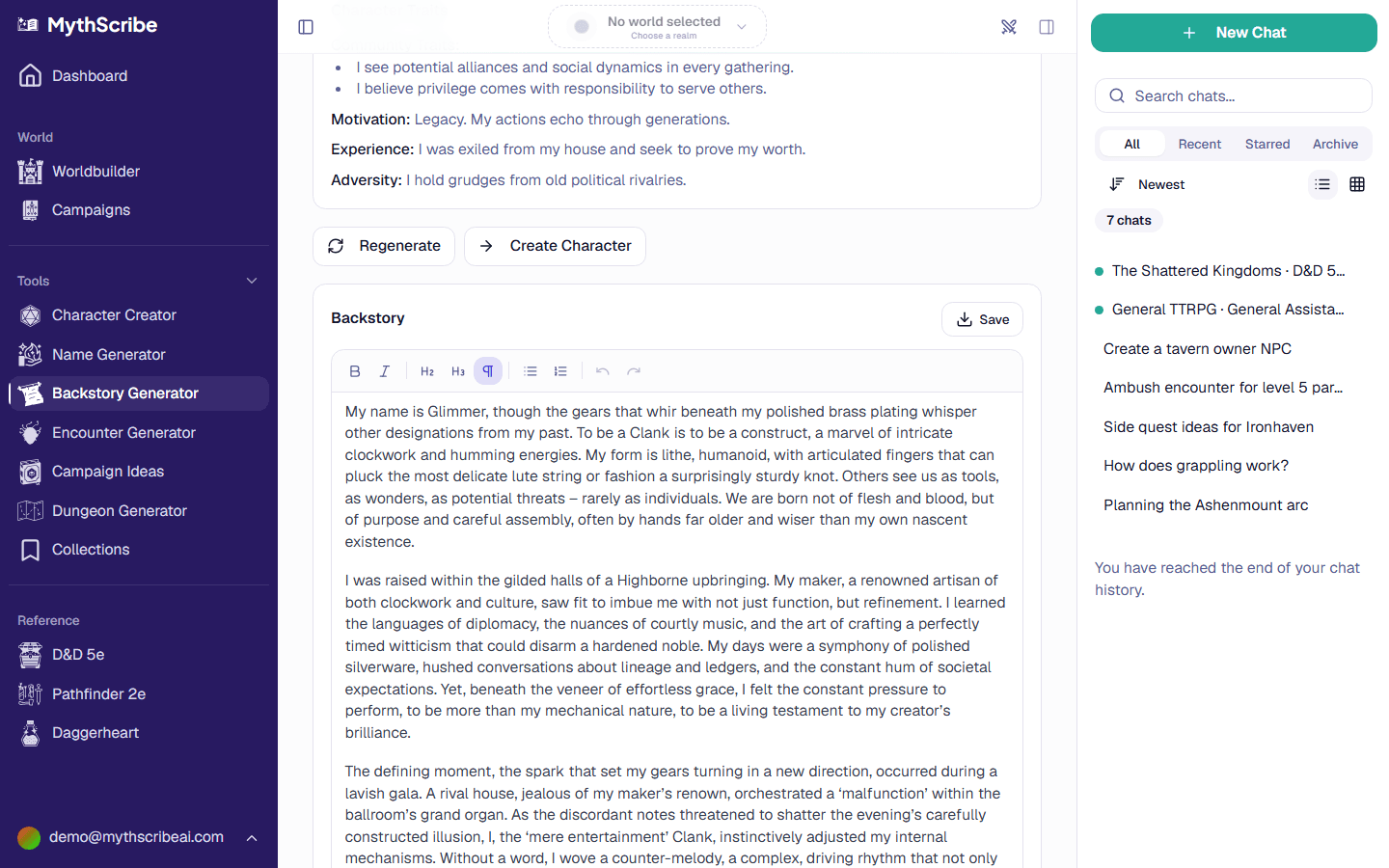 MythScribe Backstory Generator result for a Daggerheart Clank Bard from a Highborne community, with Motivation, Experience and Adversity
Pathfinder 2e
Every Pathfinder 2e character picks an ancestry, a heritage, a background and a class at level 1. Use the background as your starting point and ask what's unfinished about it. Golarion's nations and organizations give you a lot of ready-made rivals and patrons to tie your hook to.
For a full walkthrough of building a PF2e character, see our Pathfinder 2e character creator guide.
For DMs: Turning Player Backstories Into Sessions
If you're the DM reading a pile of backstories, here's how to get the most out of them:
- Pull one NPC from each backstory. Write them into your world notes before session one.
- Pick one hook per player to use in the first five sessions. It tells players their backstory matters.
- Connect two backstories. If the Rogue's old crew and the Soldier's quartermaster both deal with the same fence, you've just tied two characters together.
Keeping track of all those NPCs is easier in one place. In MythScribe's Worldbuilder, each backstory NPC becomes an entry you can link to locations, factions and quests, so the Warlock's patron and the Paladin's broken oath stay in your notes instead of your memory.
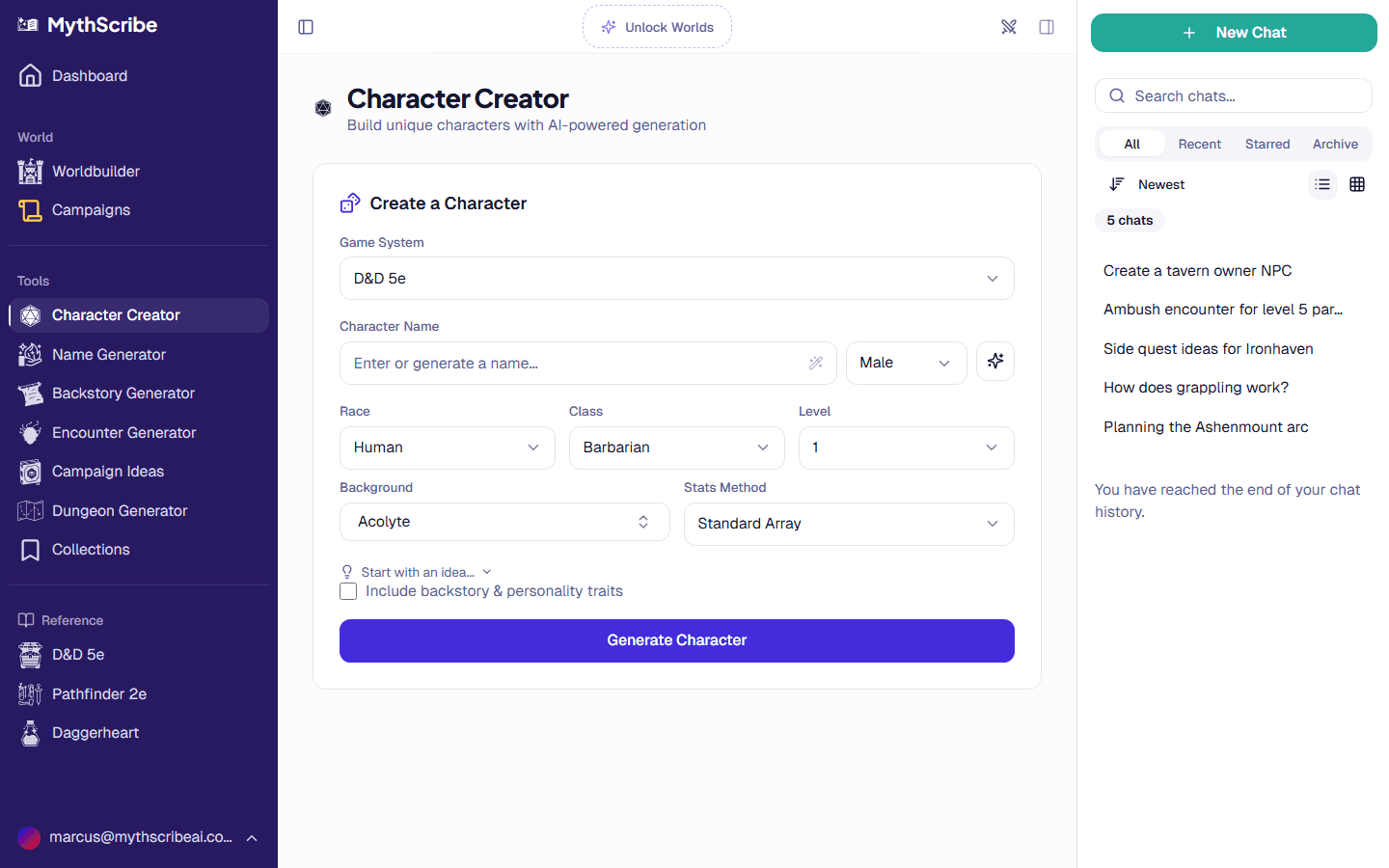 MythScribe character creator with a completed character sheet and backstory
Frequently Asked Questions
How long should a D&D backstory be?
Half a page to one page is the sweet spot. Long enough to give your DM a place, a person and a hook. Short enough that they'll actually read it. You can always add detail in play.
Should my D&D backstory be tragic?
It doesn't have to be. Dead parents are a cliché because they remove people the DM could use. A living rival, an unpaid debt or a sibling who disapproves of adventuring gives your DM much more to work with.
What if my DM ignores my backstory?
Ask them before the campaign starts which parts they're interested in. Some DMs prefer a short list of hooks rather than prose. The 5-question template above is a good format to hand over.
Is there a D&D backstory generator?
Yes. MythScribe's Backstory Generator writes backstories with personality traits, an ideal, a bond and a flaw for D&D 5e, Pathfinder 2e and Daggerheart. It can also pull from your saved world so your character's past fits the setting. Start a 7-day free trial to try it, or read our step-by-step guide to building a D&D character.
Try These Tools Free
Put what you just read into practice.