A D&D one-shot is the most useful format in tabletop. It's a complete story in a single session — usually three to five hours — with a clear hook, a contained location, and a resolution that doesn't depend on remembering a campaign you played six months ago. One-shots are how you onboard new players, fill a gap when your regular DM cancels, run a holiday game, or just see if a group has chemistry before committing to a campaign.
The hard part isn't running a one-shot — it's coming up with one that lands. A bad premise turns into the party wandering through three encounters with no stakes; a good premise gives the players a reason to care from minute one. This article is a collection of fifteen one-shot ideas that have been run, tweaked, and run again. Each one is built to fit a single session, with a hook that gets the party engaged in the first ten minutes and a structure that resolves cleanly at the end.
What Makes a Good One-Shot Premise?
Before the list, a quick filter. A one-shot premise needs four things:
- An immediate stake. The party has to want something or fear something within the first scene. Not "you've been hired by the duke" — the duke hires you, then immediately someone tries to assassinate you on the way out of the throne room.
- A contained location. A manor, an island, a single dungeon level, a city block under quarantine. If the players can wander out into a kingdom-sized world, you'll never get them home before midnight.
- A clear win condition. The players need to know — at least implicitly — what success looks like. Stop the ritual. Survive until dawn. Find the murderer. Recover the artifact.
- A built-in time pressure. Storms, rituals, escape routes closing, NPCs dying, enemies arriving in waves. Time pressure keeps the session moving and prevents the "let me check every drawer in this house" trap.
Every premise below has all four. They're written generically so you can drop them into any setting; the campaign ideas tool can flesh out tone-specific details if you want a faster prep workflow.
1. The Heist Before the Coronation
The party are mercenaries hired by a noble who's about to be crowned ruler of a small kingdom. There's just one problem: the crown jewel — required for the ceremony — was stolen by the noble's rival cousin three days ago. The coronation is at sundown. The party has eight hours to break into the rival's manor, recover the jewel, and get back without starting a civil war.
Hook: The noble explains the job; the party hears church bells in the distance, marking each hour that passes.
Twist: The "cousin" is actually working for someone else. The jewel is a relic that grants visions of past rulers. Whoever owns it can be crowned — and the rival isn't the one trying to claim it.
Why it works: Clear goal, time pressure, location is contained to the rival's manor, and there's a real moral question at the end (does the noble who hired you actually deserve the crown?).
2. The Last Train Out
A frontier town is being overrun by something — undead, a creeping plague, a demonic incursion. The last train out leaves at midnight. The party is on it. So is everyone else who could buy a ticket. So is the cause of the disaster, hiding among the passengers.
Hook: A scream from one of the passenger cars, ten minutes after departure. By the time the party investigates, someone is dead.
Twist: It's a closed-room mystery on a moving vehicle. The killer is one of five named NPC suspects, each with a motive. The "monster" everyone thinks is chasing the train is actually a containment force — and if the killer reaches the next station, whatever they're carrying gets out.
Why it works: This is "Murder on the Orient Express" with combat. The contained location is literal. Time pressure is built in (each scene ends with the train pulling into another stop where someone could escape).
3. The Funeral That Won't End
The party are guests at a funeral. The deceased was a powerful wizard whose final wish was to be buried with their spellbook. Halfway through the ceremony, the corpse sits up and asks the assembled mourners a question: "Which of you killed me?"
Hook: Every NPC in the room had a motive. The wizard's animated corpse will keep talking until they identify the murderer — and they're getting impatient.
Twist: The wizard wasn't murdered. They orchestrated their own death to expose a conspiracy among the guests. The party are pawns in their final scheme, and the real villain is whoever the wizard meant to expose.
Why it works: Locked-room mystery in a single location. NPCs have built-in opinions and tensions. Combat only happens if the players force it — which makes the moment they do force it actually matter.
4. The Door That Opens Once a Century
A door in a remote ruin opens for one hour every hundred years. Tonight is the night. The party arrives to find they aren't the only ones here — three rival expeditions are camped at the entrance, and at least one of them is willing to kill to be the first inside.
Hook: The party either chooses an alliance or fights for entry. The door opens at midnight. They have one hour inside before it closes for another hundred years.
Twist: What's inside isn't a treasure vault. It's a prison. And someone — or something — has been waiting a century for the door to open.
Why it works: Strict time limit, hostile competition, dungeon exploration with consequences for failing to leave. The "alliance vs. fight" decision in the first ten minutes hooks the party immediately.
5. The Tournament
A martial tournament is being held in the capital. Anyone can enter. The grand prize is a magical item the party desperately needs. The catch: the previous winner was murdered the night before the final match.
Hook: The party signs up. The first round is at noon.
Twist: The murderer is one of the other competitors — and they're picking off favorites one by one to ensure they win the prize themselves. The party has to win matches and solve a murder simultaneously.
Why it works: Built-in structure (rounds of the tournament), built-in pacing, and combat encounters that aren't necessarily lethal (tournament rules forbid killing — unless the murderer breaks them).
6. The Wrong Rescue
The party is hired to rescue a kidnapped noblewoman from a fortified bandit camp. They infiltrate, fight through the camp, find her, and break her out. On the way out, she reveals she wasn't kidnapped — she's the bandit leader, and the "father" who hired the party is the warlord she's been at war with. They've just helped her escape.
Hook: Standard rescue setup. The reveal happens around the midpoint.
Twist: Now the party has to decide whose side they're on. The "father" lied about who his daughter was. The "daughter" is morally grey but not evil. There's no clean answer.
Why it works: Two combat acts (infiltrating in, fighting out), a reveal that recontextualizes everything, and a moral choice at the end that defines how the session resolves.
7. The Inn at the End of the World
A snowstorm forces the party to take shelter in a remote inn. There are six other guests, all strangers to each other. Something in the storm is killing them, one by one. The doors won't open. The windows are sealed by ice. The fireplace is going out.
Hook: The first NPC dies in the second scene. The party has to figure out which of the survivors is responsible — or what's outside.
Twist: The threat is the inn itself. Or more specifically, the spirit of someone who died there. One of the surviving NPCs is the spirit's last living descendant, and they're the only ones who can banish it — but they have to die to do so.
Why it works: Pure horror/mystery with a contained location, a small cast of named NPCs, and a clock that ticks down with each death.
8. The Court of Whispers
The party is summoned to a fey court to settle a dispute. The terms are clear: they must serve as judges in three trials, and at the end of the night, they must declare a winner. If they refuse, they don't leave. If they pick the wrong side, they don't leave. The fey have all night.
Hook: Three named NPCs each present a case. The party must decide.
Twist: None of the cases have a "right" answer. The fey are testing the party's values, not their reasoning. How they decide reveals what the fey court will do to them at the end.
Why it works: Almost no combat — this is a roleplay-heavy one-shot. Great for groups that want to act, not just fight. Each trial is its own short scene with its own NPCs.
9. The Beast Below
A small village has been losing children. The local hunter says it's a wild animal. The local priest says it's a curse. The local witch says it's neither. The party investigates a series of caves beneath the village, where they find the truth.
Hook: A child goes missing on the day the party arrives. The village has hours, not days, before the next disappearance.
Twist: The "beast" is a child. One of the children taken years ago, transformed by something living deeper in the caves. Killing it is straightforward. Saving it is the harder choice — and might mean facing the deeper threat.
Why it works: A classic "monster of the week" setup with emotional stakes. The investigation phase gives roleplay room; the cave delve gives combat; the moral choice at the end gives the session weight.
10. The Wedding
The party is invited to a noble wedding. They quickly realize they're the only adventurers there. The bride and groom are from rival families that ended a war by arranging this marriage. Halfway through the ceremony, the bride collapses — poisoned. The party has minutes to find the antidote, and the suspects are all in the same room.
Hook: The poisoning happens in the first scene. The clock starts immediately.
Twist: The poison was meant for the groom. The bride drank from his cup by mistake. The killer didn't expect this — they're now scrambling, which gives the party leverage if they can spot who's panicking.
Why it works: Time pressure, locked-room mystery, no need to leave the wedding venue. Investigation rolls drive the session, with a final confrontation at the climax.
11. The Tax Collector
The party is hired to collect overdue taxes from a remote farming village. Standard work. They arrive to find the village abandoned — except for one person, an elderly farmer who tells them everyone left because of "the thing in the well."
Hook: The villagers haven't gone far. They're hiding in the surrounding fields, waiting for the party to deal with the well.
Twist: Whatever was in the well isn't there anymore. It's in the farmer who greeted them. The "abandoned village" was a trap.
Why it works: Slow-burn horror with a clear escalation. Starts as a simple errand, becomes survival horror by the second hour.
12. The Auction
A black-market auction is being held in a city's underground. The party has been hired to acquire a specific item — a sealed reliquary — without raising suspicion. Other bidders include a rival adventuring party, a noble's agent, a thieves' guild representative, and a mysterious figure in a hood.
Hook: The auction starts at sunset. The party has an hour to scout the venue and identify the other bidders' weaknesses.
Twist: The reliquary's contents are sentient. As soon as it's opened, it will choose a new owner — regardless of who paid. The party's employer didn't tell them this. Whoever ends up holding the reliquary at the auction's close becomes the target of every other faction in the room.
Why it works: Roleplay-heavy social encounter, a chase or fight at the end depending on outcomes, and a structure (rounds of bidding) that paces the session naturally.
13. The Last Stand
A village has thirty minutes before a horde of [your favorite enemy type] arrives. The party can't outrun them. The villagers can't either. The only option is to defend the village. The party has the half hour to recruit allies, set traps, and prepare.
Hook: Tower bell rings. The horde is on its way.
Twist: The horde isn't attacking the village — they're fleeing toward it. Whatever they're running from arrives ten minutes after they do.
Why it works: Two-stage combat with prep time in between. The "build a defense" phase gives players agency over the encounter design; the "what's chasing the horde" reveal at the end raises stakes for the climax.
14. The Investigator
The party is the local investigator, called to look into a death. The setting is constrained — a single building, a small town, a ship. Everyone in the location is a suspect. The party has six hours of in-game time to solve the case before the killer escapes or strikes again.
Hook: The body. Three pieces of evidence in plain view. One witness who is clearly lying.
Twist: There were two crimes, not one. The first crime is the obvious one. The second is harder to spot — and far more important.
Why it works: Classic mystery format that fits naturally into a session length. Each "scene" is an interrogation or evidence search; the climax is the accusation. Use the NPC generator to flesh out the suspects with motivations and tells.
15. The Resurrection
A deceased mentor figure (someone the party knew and trusted) appears in a vision and asks them to resurrect them. They've left instructions: ingredients, location, ritual. The party must gather the components and perform the ritual in a single night.
Hook: The vision tells them they have until sunrise.
Twist: The mentor doesn't want to be resurrected. The "vision" is an enemy who took their form, trying to use the party to bring something else back from death.
Why it works: A scavenger-hunt structure (gather components, each with its own challenge) leading to a climactic ritual that reveals the truth. Emotional payoff if the party knew the mentor in a previous campaign — but works fine cold for new groups.
How to Prep a One-Shot in 30 Minutes
The premise is the hard part. Once you have it, the rest is mechanical. Here's how to prep any one-shot in roughly half an hour:
- Write the opening scene. First five minutes of the session. What does the party see, hear, and want?
- Decide the win and lose conditions. What does success look like? What happens if they fail?
- List 4-6 named NPCs. For each: one sentence about who they are, one sentence about what they want, one detail you can play in voice (a tic, a phrase, a way of standing).
- Plan three encounters. They don't all have to be combat. A negotiation, a trap, a chase, a puzzle, a moral dilemma. Mix them.
- Think about pacing. When does each beat happen? Roughly: hook in the first 30 minutes, complication around the 90-minute mark, climax at hour three to four, resolution at hour four to five.
That's it. You don't need a battle map for every encounter. You don't need stat blocks for NPCs the party will only talk to. You don't need to know the lore of the kingdom — the party doesn't need to know it either.
If you want to skip the planning entirely, the campaign ideas tool can generate a one-shot premise with NPCs, locations, and a three-act structure in about fifteen seconds. The encounter generator handles the combat side. Use them to skip the staring-at-a-blank-page stage; spend your prep time on the parts of the session that need your judgment.
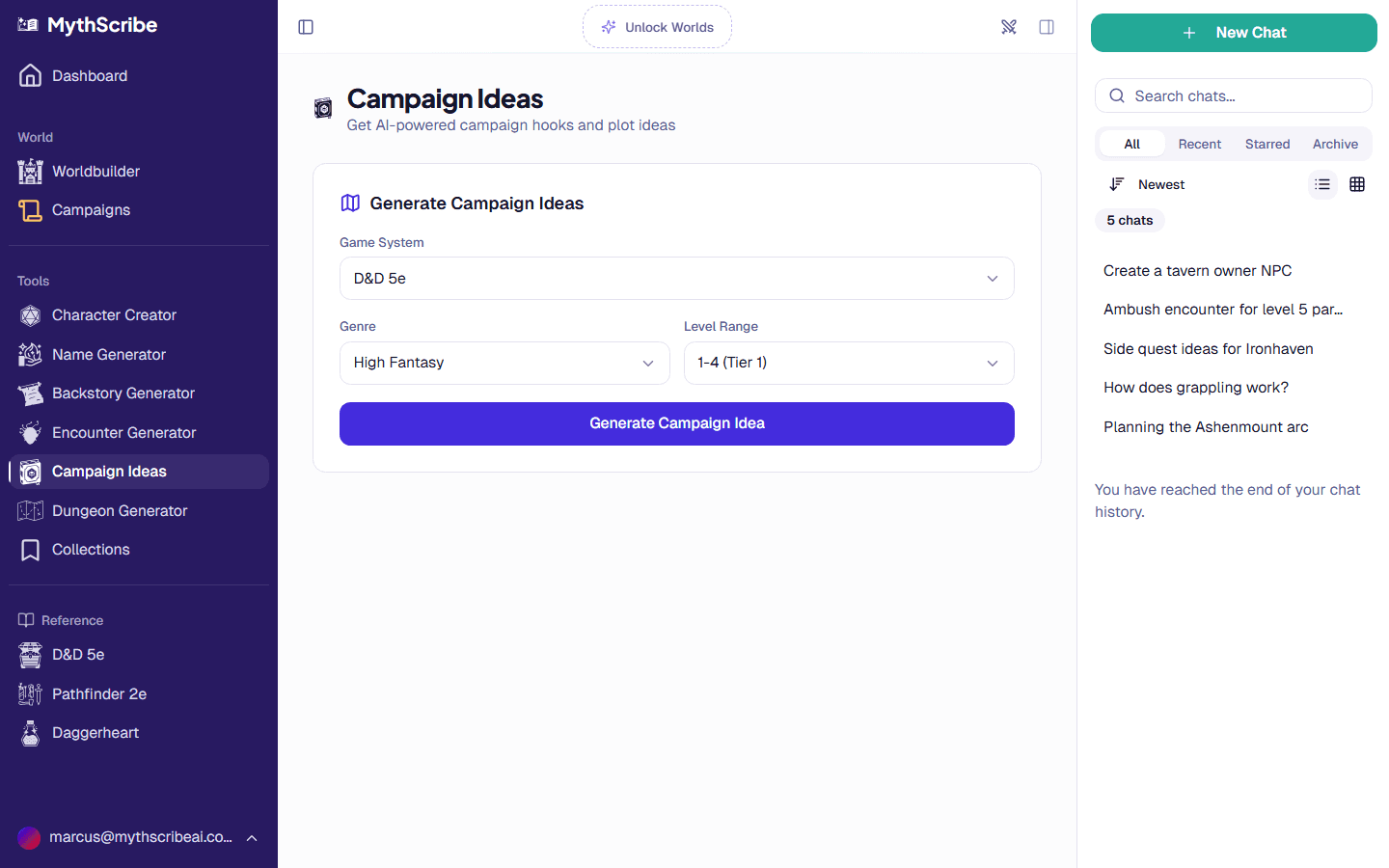 The campaign ideas form, set to "One-Shot" with a 4-hour duration and Mystery genre
Tips for Running One-Shots
A few things that experienced one-shot DMs tend to learn the hard way:
- Pre-generate characters. Don't spend the first hour of a four-hour session building characters. Have four to six pre-mades ready, each with a hook into the premise. Players pick from the list.
- Tell the players the genre. "This is a horror one-shot." "This is a heist." "This is a court mystery." Players make better characters and lean into the right tone when they know what they signed up for.
- Skip downtime. A one-shot has no rest scenes, no tavern roleplay, no shopping trips. Every scene drives the plot. Cut anything that doesn't.
- End on time. If you said four hours, end at four hours. Players forgive a slightly rushed climax; they don't forgive a session that runs past midnight on a weeknight.
- Tell the players when stakes are real. D&D's default mode is "the party probably wins." In a one-shot, that's not always true. If a TPK is possible, say so before the session starts. Some groups want stakes; some don't. Calibrate.
Reusing One-Shots
A good one-shot premise can be run two or three times with completely different parties and feel new each time. The framework is the same; the players' choices fill in the rest. Keep notes after each run — what worked, what didn't, which NPCs the players latched onto. Many of the most-loved campaign settings started life as a one-shot the DM kept getting asked to run again.
If a one-shot lands hard, that's also your campaign. The cast that survived the first session becomes the recurring party. The location they cleared becomes the home base. The villain who escaped becomes the campaign's antagonist. The premise of how a campaign comes together often starts here.
Where to Go from Here
If you want to run any of these tonight, pick one and prep it now — don't wait. The list isn't exhaustive; it's a starting point. Use the AI campaign generator to develop tone-specific versions, or the name generator to fill out NPCs in a few seconds. Build the world only as deep as the session needs.
One-shots are the lowest-stakes format in tabletop. If a session doesn't land, you tried a thing for four hours and now you know. If it does land, you might just have your next campaign.
Try These Tools Free
Put what you just read into practice.