Campaign prep is the bottleneck that kills more D&D campaigns than bad dice rolls ever will. You sit down on a weeknight to plan the next session and realize you need a villain with a coherent motive, three faction conflicts that actually intersect, a story arc that accounts for what the party did last time, and enough flexibility to survive first contact with your players. That's hours of work for a single session — and you haven't even touched encounter design.
An AI campaign generator changes the math. Not by replacing your creative judgment, but by doing the structural heavy lifting in minutes instead of hours. You still decide the tone, the themes, and the moments that matter. The AI handles the scaffolding: generating premises, connecting plot threads, building faction dynamics, and producing session-ready content you can customize for your table.
This guide walks through what AI campaign generators actually do, how to use them effectively, and where the technology genuinely helps versus where you still need a human behind the screen.
What Is an AI Campaign Generator?
An AI campaign generator is a tool that uses large language models to produce structured campaign content — story arcs, villain profiles, quest hooks, faction conflicts, and session outlines — based on parameters you provide. You describe the genre, tone, game system, party composition, and any constraints, and the AI generates a campaign framework you can run or modify.
This is fundamentally different from random generators. A random campaign generator rolls on tables: a random villain type, a random location, a random MacGuffin. The results are disconnected — a lich in a desert guarding a stolen crown, with no explanation for why any of those elements relate to each other.
An AI campaign generator produces coherent content. The villain has a motivation that connects to the setting. The quest hooks emerge from faction conflicts. The story arc has a beginning, middle, and escalation that makes narrative sense. It's the difference between rolling on a table and having a conversation with a co-writer who understands story structure.
That said, AI generators are not game designers. They produce strong first drafts that need your editorial judgment. The output is a starting point — useful, structured, and dramatically faster than starting from scratch — but not a finished product.
How AI Changes Campaign Prep
The traditional campaign prep workflow looks something like this: you spend 4-8 hours before session one building a world, designing NPCs, writing a villain, planning a story arc, and generating encounters. Then you spend 1-3 hours before every subsequent session maintaining continuity, designing new content, and adapting to what the players did.
AI compresses the mechanical parts of this work. Here's where the impact is most significant.
Story Arcs and Three-Act Structure
Building a campaign arc manually means deciding on a premise, planning escalation beats, designing a midpoint complication, and structuring a climax — all before you've played a single session. An AI campaign planner generates complete three-act structures in seconds, including act transitions, stakes escalation, and suggested session breakdowns. You pick the arc that resonates and modify it to fit your table.
Villain Motivations
Good villains need goals that make sense in context, plans that are already in motion, and personal connections to the party. Generating three villain profiles with distinct motivations takes an AI 30 seconds. Doing the same manually takes an hour or more, and most DMs settle for the first idea rather than exploring alternatives.
Session-to-Session Continuity
The hardest part of running a long campaign is remembering what happened and making it matter. AI tools that maintain context — like a worldbuilder that tracks NPCs, factions, and events — let you generate session content that references prior events without re-reading your entire notes archive.
Faction Dynamics
Factions that feel alive need competing goals, shifting alliances, and reactions to player actions. An AI can generate a faction web with 4-6 groups, their relationships, and how those relationships change based on party decisions. Building this by hand is a spreadsheet project. Building it with AI is a conversation.
Step-by-Step: Building a Campaign with AI
Here's the actual workflow for building a campaign using MythScribe's tools. This isn't theoretical — it's the process that takes a blank page to a session-ready campaign in under an hour.
Step 1: Generate the Campaign Framework
Open the Campaign Ideas generator and provide:
- Game system: D&D 5e, Pathfinder 2e, or Daggerheart
- Genre/tone: dark fantasy, political intrigue, exploration, horror, heroic
- Party size and level range
- Any constraints: themes you want to explore, elements you want to include or avoid
The generator produces a full campaign framework: premise, three-act structure, main villain with motivation and tactics, 2-4 faction conflicts, and 6-8 quest hooks that connect to the main arc.
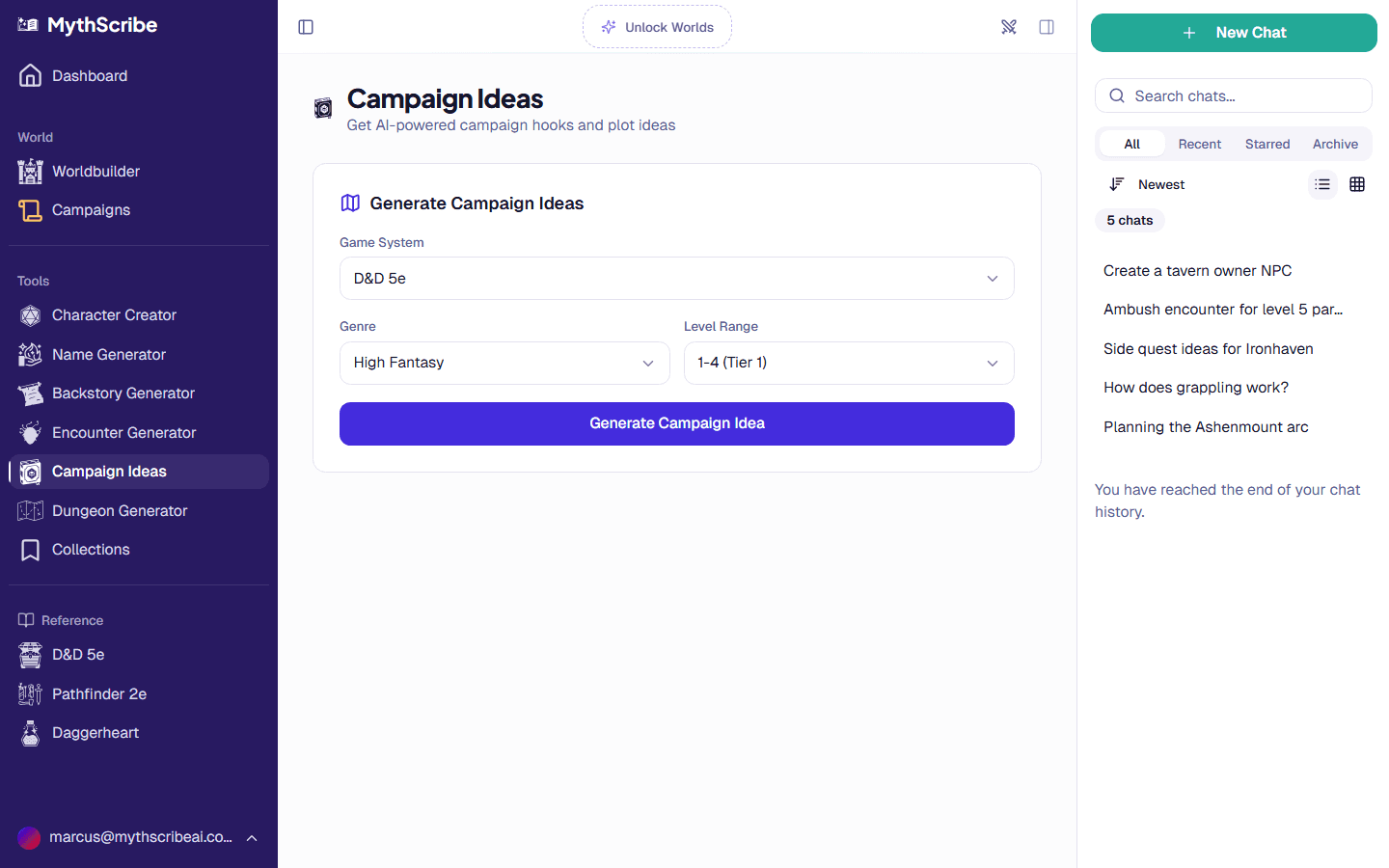 Campaign generator form
Step 2: Refine with AI Chat
The generator gives you structure. The AI chat lets you develop it. Take the framework into a conversation and start asking questions:
- "The villain's motivation feels generic — what if they genuinely believe they're saving the world?"
- "I need a faction that opposes both the villain and the party. What would that look like?"
- "My party has a warlock whose patron is an archfey. How can I tie that into the main arc?"
The chat maintains context within the conversation, so each question builds on the last. This is where a DND campaign generator becomes a campaign collaborator — not just producing content, but helping you think through the implications of your choices.
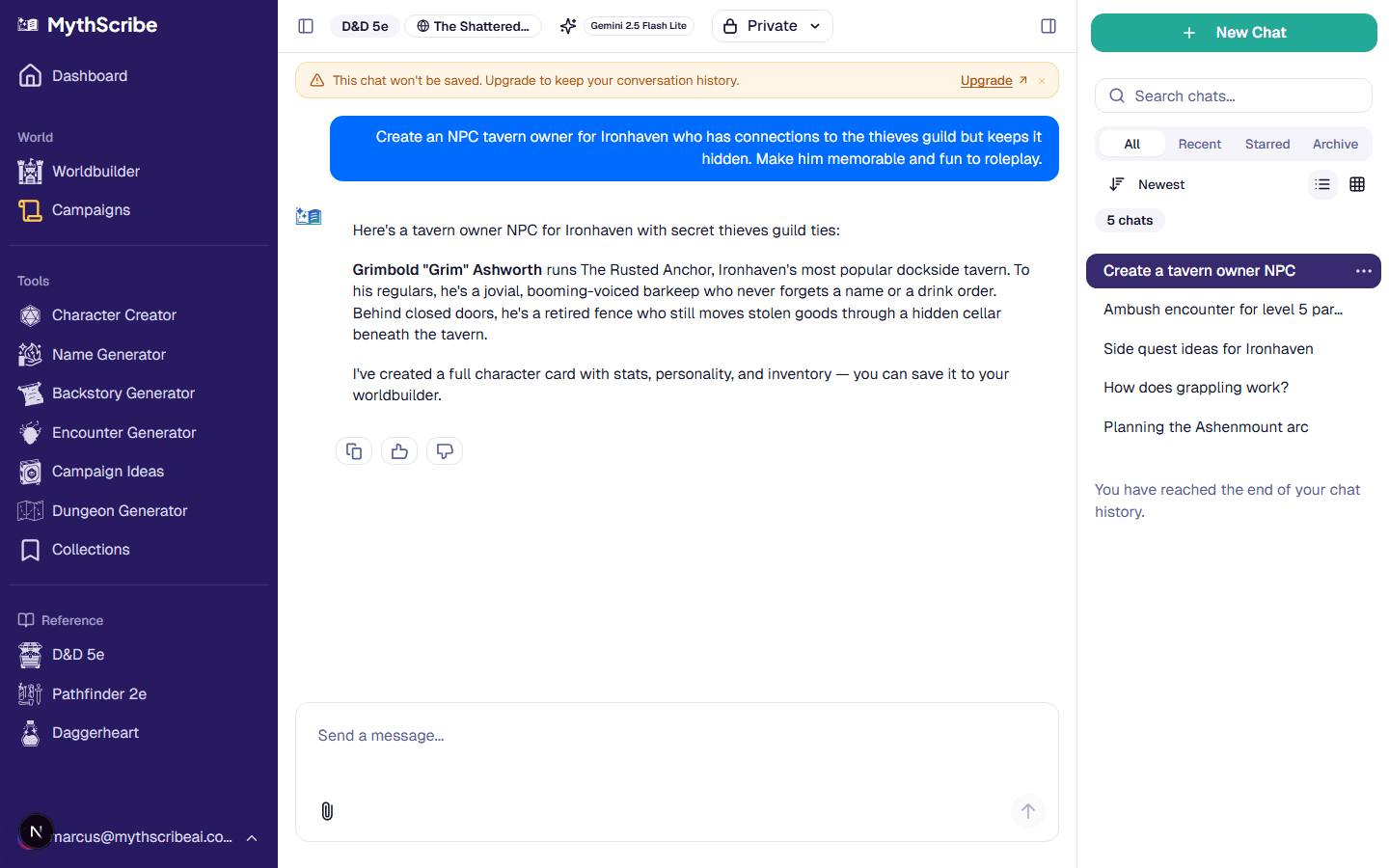 AI chat for campaign planning
Step 3: Build the World
Once you have a framework you like, start logging the key elements in the Worldbuilder:
- Factions with their goals, leaders, and relationships
- Key NPCs with motivations, secrets, and connections to the party
- Locations that matter for the first few sessions
- The villain as a separate entry with their plan timeline
The worldbuilder isn't just storage — it's context. When you return to the AI chat or any generator later, the AI can reference your world. Ask it to generate an NPC and it knows your factions. Ask for a quest hook and it knows your villain's plan.
Step 4: Plan Session One
With the framework, NPCs, and world in place, plan the first session specifically:
- Opening hook: what happens in the first 10 minutes
- Key encounters: one combat, one social, one exploration moment
- Closing hook: what makes the players want to come back
Generate encounters with the Encounter Generator, using the context from your campaign framework to ensure the enemies and environment match your story.
Step 5: Iterate After Each Session
After every session, update the worldbuilder with what happened. New NPCs, faction changes, player decisions that shifted the story. The next time you prep, the AI already knows the current state of the campaign.
This is where AI campaign prep becomes dramatically faster over time. Session one takes an hour to plan. By session five, you're prepping in 15-20 minutes because the AI has enough context to generate content that fits your specific campaign.
AI vs. Manual Campaign Prep
| AI-Assisted | Fully Manual | |
|---|---|---|
| Time to first session | 1-2 hours | 6-12 hours |
| Per-session prep | 15-30 minutes | 1-3 hours |
| Story arc quality | Strong scaffolding, needs personal touches | Fully personalized from the start |
| Villain depth | Good first draft, improve through iteration | As deep as your time allows |
| Faction consistency | High — AI tracks relationships | Depends on your note-keeping |
| Flexibility | Easy to regenerate when plans change | Rework is time-consuming |
| Cost | Tool subscription (often free tier available) | Free, but time-intensive |
| Player-specific content | You add this layer | You add this layer |
The bottom row is the same for both columns on purpose. No tool — AI or otherwise — knows your players. That layer is always yours.
What AI Can't Replace
Being honest about limitations matters more than overselling the technology. Here's what an AI campaign generator genuinely cannot do.
Player Agency
The best campaign moments come from players making choices you didn't anticipate. AI can help you prepare for multiple possibilities, but it can't predict what your specific players will do with the freedom you give them. Your job as a DM is to build a world that responds to choices, not a script that requires them.
Improvisation at the Table
When the bard tries to seduce the dragon, when the rogue decides to betray the party for perfectly in-character reasons, when the players come up with a plan so absurd it loops back around to brilliant — those moments are unscriptable. AI prep gives you a stronger foundation to improvise from, but the improvisation itself is entirely human.
Emotional Tone
AI can generate a villain's backstory. It can't tell you how to deliver the moment when the party discovers the villain was right all along. Pacing, dramatic pauses, the shift in your voice when an NPC is frightened — these are performance skills that no generator replicates.
Table-Specific Humor and Culture
Every table develops its own inside jokes, running gags, and cultural touchstones. The campaign generator DND groups love most is one that accounts for their specific history. AI doesn't know that your party calls every tavern "Dave's" or that the running joke is the paladin's inability to open doors. You do.
Best Practices for Using AI Campaign Generators
After watching DMs use these tools for hundreds of campaigns, patterns emerge. Here's what works.
Use AI as a Starting Point, Not a Final Product
Generate three campaign premises. Pick the one that excites you most. Then rewrite the parts that don't fit your vision. The AI's job is to get you past the blank page and into the editing phase, where your creativity as a DM takes over.
Provide Specific Context
"Generate a campaign" produces generic output. "Generate a dark fantasy campaign for four level-3 characters where the main threat is a corrupted druid circle and the tone is survival horror" produces something you can actually use. The more specific your input, the more useful the output.
Maintain Continuity Through Your Worldbuilder
The single biggest advantage of AI campaign prep is cumulative context. Every NPC, event, and faction you log makes future generation more relevant. DMs who skip the worldbuilder get diminishing returns. DMs who maintain it get increasing returns.
Customize for Your Table
After generating content, ask yourself: does this fit my players? The AI doesn't know that your group hates puzzles, or that one player is dealing with real-life grief and doesn't want character death this arc. Apply your table knowledge to everything the AI produces.
Don't Over-Generate
It's tempting to generate 20 quest hooks, 15 NPCs, and a full faction web before session one. Resist. Generate what you need for the next 2-3 sessions. The campaign will evolve based on player choices, and over-generating creates content you'll never use — or worse, content you'll feel pressured to force into the story.
Iterate, Don't Restart
When a generated campaign arc doesn't feel right after session 3, don't scrap it and regenerate from scratch. Take what's working into the AI chat and ask it to help you pivot. "The players aren't interested in the political subplot — how can I redirect the villain's plan toward the dungeon exploration they actually enjoy?" This kind of mid-campaign course correction is where AI tools genuinely shine.
FAQ
Is there an AI campaign generator for D&D?
Yes. MythScribe's Campaign Ideas generator creates full campaign frameworks for D&D 5e, Pathfinder 2e, and Daggerheart — including story arcs, villain profiles, faction conflicts, and quest hooks. The AI chat lets you develop and refine those frameworks in conversation. Both tools are available with a free trial.
Can AI write a D&D campaign?
AI can generate a strong campaign framework — premise, structure, villain, factions, and quest hooks — in minutes. It produces a first draft, not a finished product. The best results come from using AI-generated content as a starting point and then customizing it for your table, your players, and the specific story you want to tell.
What is the best AI tool for D&D campaign prep?
For campaign-specific generation, look for tools that produce structured output (not just freeform text) and maintain context across sessions. MythScribe combines a campaign ideas generator, an AI chat for iterative development, and a worldbuilder that tracks your campaign state — so the AI gets smarter about your specific campaign over time.
How do I use AI to plan a D&D campaign?
Start with an AI campaign generator to produce a framework (premise, arc, villain, factions). Refine it through AI chat conversation. Log the key elements in a worldbuilder. Plan session one specifically — opening hook, key encounters, closing hook. After each session, update the worldbuilder and use the AI to generate content for the next session with full context.
Will my players know I used AI for campaign prep?
No. The AI generates structural content — arcs, stat blocks, NPC profiles, quest hooks. What your players experience is how you run that content at the table: your voice acting, your pacing, your reactions to their choices, and the personal touches you add based on knowing your group. AI handles the scaffolding; you handle the performance.
Try These Tools Free
Put what you just read into practice.