Building a D&D campaign from scratch is one of the most rewarding things you can do as a DM — and one of the most daunting. A campaign isn't just a series of sessions. It's a collaborative story with stakes, history, recurring characters, and an ending that (ideally) feels earned. This guide walks through how to make a D&D campaign that holds together from session one to the finale, without spending more prep time than you can sustain.
What Makes a Campaign Different from a One-Shot?
A one-shot is a complete story in a single session. A campaign is an ongoing story that evolves based on what the players do. This distinction matters because it changes what you need to prepare.
For a campaign, you need:
- A premise — the core conflict or question the campaign explores
- A structure — a loose sense of beginning, middle, and end
- A world — the setting with enough detail to feel real, but not so much that you're writing a novel before the first session
- NPCs that persist — characters who remember what the party did and react accordingly
- Player investment — reasons for each character to care about the story
Everything else — specific encounters, dungeon layouts, session events — can be built as you play. The best campaigns are partly planned and partly reactive.
Step 1: Choose a Premise
A campaign premise is one sentence that captures what the story is about. Not what happens, but what it's about. A few examples:
- "The party must stop an ancient god from returning to the world by destroying the five artifacts that sustain it."
- "A merchant company hired to transport a package discovers the package contains something that could destabilize the kingdom."
- "A group of strangers with criminal records are offered pardons in exchange for clearing out a newly discovered continent."
Notice what these have in common: a clear goal, a reason for the party to work together, and implied stakes. The premise doesn't need to be original. The execution is what makes it yours.
If you're stuck on a premise, start with a genre and a central question:
- High fantasy: Who should rule when the king is dead?
- Horror: What price are you willing to pay to survive?
- Political intrigue: Can people on opposite sides of a war do the right thing?
- Exploration: What's worth risking everything to discover?
The AI campaign generator can generate full premises with three-act structure, villain motivations, and faction conflicts if you give it a genre and a tone. Good for breaking decision paralysis or generating options you can then choose between.
Step 2: Build the Three-Act Structure (Loosely)
A three-act campaign gives you an arc without constraining player choice. The acts are loose containers, not a script:
Act 1 — Establishment (sessions 1-4 approximately): The party meets, the world is introduced, and the central conflict becomes clear. The players are mostly reacting to events rather than driving them. End of Act 1: the stakes raise significantly — a mentor dies, a city falls, or the party learns the threat is bigger than they thought.
Act 2 — Complication (sessions 5-12 approximately): The party is active in pursuing their goal, but obstacles and complications make simple solutions impossible. This is where subplots develop, relationships form, and player choices have consequences. The middle of Act 2 is often the hardest to DM — the novelty has worn off but you're not close enough to the finale for momentum to carry you. End of Act 2: a major setback. The villain wins a significant victory, the party loses something important, or a betrayal changes everything.
Act 3 — Resolution (sessions 13+ approximately): The party moves toward the final confrontation with full knowledge of what they're up against. Subplots resolve. The finale delivers on what the campaign has been building. Post-climax: a scene or session to let the characters breathe and say goodbye.
This structure is a framework, not a commitment. If players take the story somewhere unexpected in Act 2, follow them. The structure helps you know where you are and what you need to set up.
Step 3: Design the Main Villain
A campaign is only as strong as its villain. Good villains have:
A goal the players can understand, even if they don't agree with it. The best villains aren't evil for its own sake — they want something that makes sense in their worldview. Power, revenge, love, survival, justice (in a twisted form). If you can explain the villain's motivation without using the word "evil," you have a better villain.
A plan that's already in motion. The players should feel like they're racing against something, not waiting for the villain to react. What has the villain already done? What are they doing right now, off-screen?
A personal connection to at least one player character. Not always possible in session one, but try to create a link between the villain and someone at the table — a past connection, a shared history, a belief system in opposition. This makes the finale feel personal.
Real consequences for player failure. Villains who are always stymied by the party become less threatening over time. Let the villain win sometimes. A city gets sacked, an NPC dies, a plan succeeds. Players respect villains who are actually dangerous.
Step 4: Build the World You Need (Not the World You Want)
New DMs overbuild. They create detailed histories, draw maps of entire continents, and design factions for regions the party will never visit — all before the first session. Then they burn out and the campaign dies in session 3.
Build only what you need for the first session, plus enough to answer predictable questions:
- The starting location: a town or city with a name, a feel, and 3-5 named NPCs
- The inciting event: what starts the campaign
- The immediate threat: what's happening right now that requires action
- The first dungeon or encounter location: wherever the first session ends up
Everything beyond this can be built as you play. Reactive worldbuilding — creating places and people in response to what players ask about — often produces better content than pre-planned content, because it's directly relevant to what the players care about.
A worldbuilder is invaluable here because it lets you add content as you discover it. When the players name a merchant and you give her a backstory on the fly, you log it immediately and the AI remembers it for every future session.
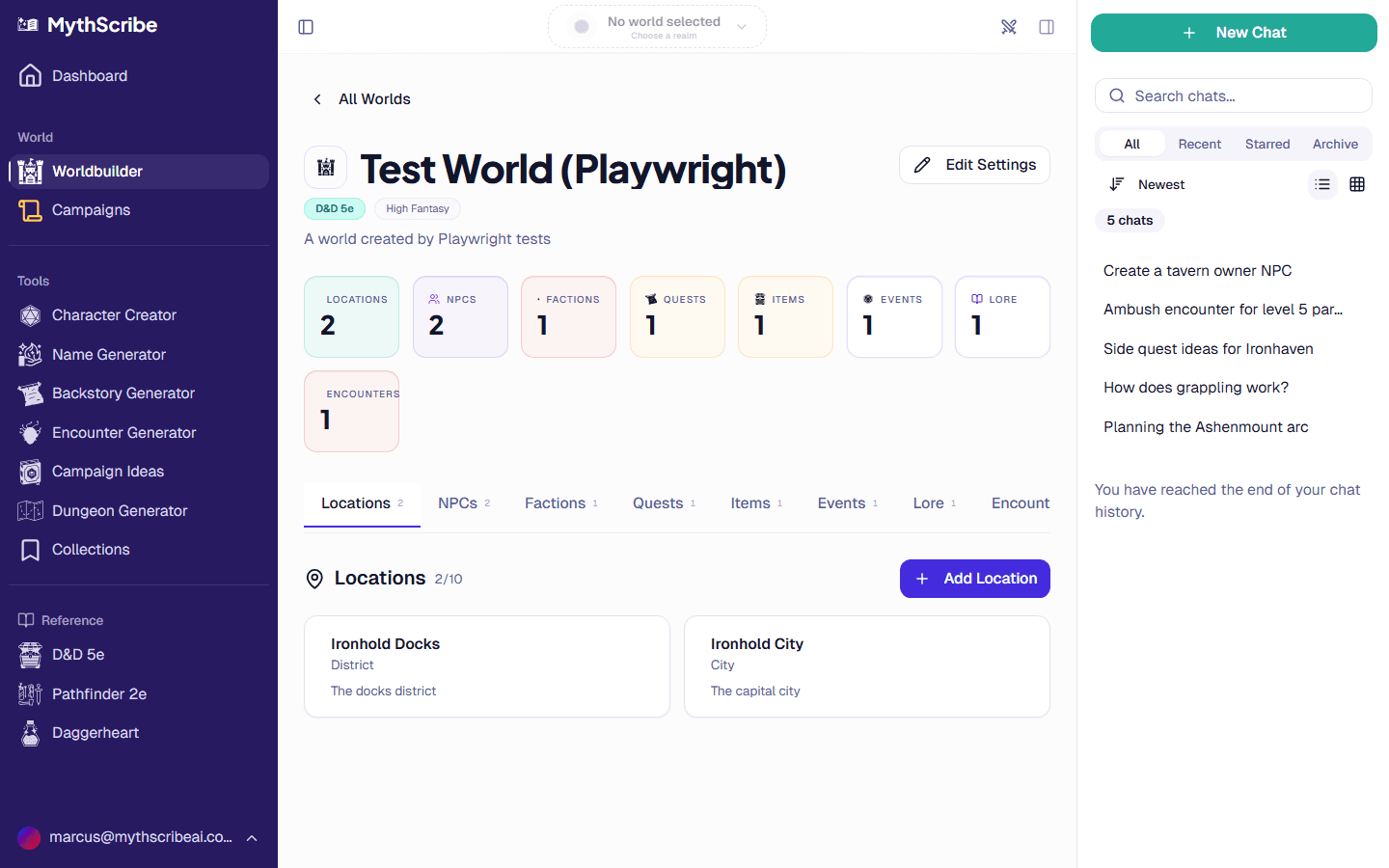 MythScribe worldbuilder with factions, NPCs, and locations organized
Step 5: Create Your Starting NPCs
You need 3-5 named NPCs with distinct personalities before session one. These are the people the party interacts with first, and first impressions matter.
For each NPC, define:
- What they want (their goal)
- What they fear (their vulnerability)
- A distinctive trait (a speech pattern, a habit, a physical detail)
- Their relationship to the party (employer, quest-giver, contact, antagonist)
That's enough. You don't need full backstories for every NPC before the campaign starts. The backstory often emerges through play — you discover it when players start asking questions.
The NPC generator produces full NPC profiles including personality, motivation, secret, and appearance in seconds. Use it to generate 8-10 NPCs quickly, then pick the 3-5 you like best for session one. Save the others for later.
Step 6: Plan Session One Specifically
Session one is the only session you need to plan in detail before the campaign starts. For every other session, general prep is enough — session one is the exception.
What makes a good first session:
Start in action, not setup. Players don't want a 20-minute exposition dump before anything happens. Start with something happening — an attack, a discovery, a crisis, a job offer with immediate stakes. Exposition can come later, when the players are already invested.
Give every character a moment. Even in session one, find a way to spotlight each character's abilities or personality. A skill check that only they can make, a social moment suited to their background, a combat decision that shows what they can do.
End with a hook. The last 10 minutes of session one should set up what the party will do next. Not a cliffhanger necessarily — just a direction. "The map shows a cave system north of town" is enough. Players need to leave knowing they have a destination.
Set the tone. Session one establishes what kind of campaign this is. If it's horror, put something genuinely unsettling in session one. If it's political intrigue, introduce conflicting factions and competing loyalties from the start. Tone established in session one is much easier to maintain than tone you try to introduce later.
How AI Tools Speed Up Campaign Creation
A full campaign can take 8-12 hours to plan manually before the first session — setting, NPCs, encounters, the villain, the structure. AI tools can cut this to 2-3 hours without sacrificing quality.
Here's what the workflow looks like:
Generate the premise and structure (20-30 min): Describe the genre, tone, and any constraints (system, player count, expected length). The AI campaign generator produces a full campaign premise with act structure, villain profile, faction conflicts, and 6-8 quest hooks. Pick the elements that resonate, discard the rest.
Generate NPCs (5-10 min each): Describe the NPC's role and the AI produces a complete character. Five NPCs takes 30-40 minutes rather than 2+ hours.
Generate encounters (5 min each): Specify the narrative purpose, environment, and party level. The AI builds a CR-balanced encounter with monsters, tactics, and terrain.
Generate the starting dungeon if needed (5 min): The dungeon generator produces a room-based map with corridor routing. Export as PNG for your VTT.
Log everything to your worldbuilder (ongoing): As you generate content, log it so the AI can reference it in future sessions. When you're running session 7 and ask for an NPC interaction, the AI knows who the party already knows and what happened.
D&D Campaign Ideas by Genre
Not sure what kind of campaign to run? Here are starting premises that work well at the table, by genre:
High Fantasy: The party discovers that the five kingdoms are actually sustained by an ancient magical compact — and someone is deliberately breaking it. Each kingdom's ruler has a different piece of the story and a different incentive to lie.
Horror: A village has started experiencing shared nightmares. When the party investigates, they find the nightmares are real — something is eating the collective memory of the town and the party has already been inside it without knowing.
Political Intrigue: The king is dying and has no heir. Three factions — the church, the military, and the merchant guilds — all have different candidates and will use the party as pawns if they're not careful.
Exploration: A continent that was thought uninhabitable turns out to have had an advanced civilization that collapsed 300 years ago. The party is hired to map it, but they're not the only expedition.
Redemption Arc: The party begins as hired mercenaries for a morally dubious employer. The campaign is about how they choose to use the power and information they accumulate over time.
FAQ
How long should a D&D campaign be?
Most long-term campaigns run 20-50 sessions, covering roughly levels 1-15 or 1-20. Mini-campaigns (sometimes called "arcs") run 6-12 sessions and work well for groups with busy schedules. There's no wrong length — the right campaign length is whatever your group will actually finish.
How do I keep players engaged in a long campaign?
Give each player character a personal goal that ties into the main plot. Players stay engaged when their character's story is progressing, not just when the main quest is. Check in between sessions — what does your character want from the next session? That answer tells you what to prepare.
How much prep time does a D&D campaign need per session?
For homebrew campaigns, expect 1-3 hours per session once the campaign is established. Session one takes longer. Familiarity with your world and players reduces prep over time. AI tools can reduce this significantly — a well-logged worldbuilder means you spend less time re-reading notes and more time planning new content.
Can I run a campaign for beginners?
Yes, and beginner campaigns are often more fun to DM than experienced-player campaigns because small moments land harder. Start at level 1, keep the stakes personal before they become cosmic, and introduce rules gradually rather than all at once. The Lost Mine of Phandelver starter set is the standard recommendation — study its structure even if you're running homebrew.
How do I handle players who go off-script?
Assume they will, and build a world that responds to choices rather than a plot that requires them. When players go somewhere unexpected, ask: what would logically happen here given the NPCs, factions, and events in play? Usually the answer generates better content than anything you would have planned.
Try These Tools Free
Put what you just read into practice.