The professional dungeon master is no longer a novelty. Platforms like StartPlaying.games have made paid tabletop sessions a real market, and DMs who can run consistently excellent games are building subscriber bases, repeat clients, and genuine side incomes. If you've been running games for years and wondering whether you could get paid for it, the short answer is yes — but the path requires more than just being a good DM.
This guide covers everything: what professional dungeon mastering actually looks like, how to get your first clients, what to charge, and how to use AI tools to handle the prep workload that comes with running paid games professionally.
What Is a Professional Dungeon Master?
A professional dungeon master is a DM who charges for running tabletop RPG sessions. This can take several forms:
- Per-session fees — the most common model. You charge a flat rate per session, per player, or a combination.
- Campaign packages — clients pay upfront for a block of sessions (e.g., a 10-session campaign at a set price).
- Corporate team-building — companies hire DMs to run one-shots for their teams. Rates here are significantly higher.
- Online instruction — teaching DM skills through courses, one-on-one coaching, or content creation.
Most professional DMs combine at least two of these. The core skill set is the same in every case: running consistently good games, showing up prepared, and managing the client relationship professionally.
Who Hires a Professional Dungeon Master?
Understanding your audience matters before you set pricing or start marketing. The typical clients for paid DM sessions fall into a few categories:
New players who want to learn in a structured environment. These clients want someone who will teach the rules patiently while running an engaging story. Sessions are usually shorter and at lower levels. They're often willing to pay a premium because they don't know any DMs personally.
Busy adults who want to play but can't recruit a group. The standard narrative about D&D — that you need friends who all have the same free time — makes it inaccessible for many adults. A professional DM solves the social coordination problem by assembling tables.
Established groups who want to be players, not DMs. Groups with an experienced player who's always been the DM often hire a pro DM so that person can finally play. These clients know the rules, have strong opinions, and need a DM who can keep experienced players engaged.
Corporate clients. One-shots for team-building events. Logistics are more complex but rates are 2-3x normal, and single-session commitments keep your schedule flexible.
How Much Do Professional DMs Charge?
Rates vary widely based on experience, platform, and client type. As a general benchmark from the current market:
| Experience Level | Per-Session Rate | Per-Player Rate |
|---|---|---|
| New (0-1 year pro) | $20–40/session | $5–10/player |
| Intermediate (1-3 years) | $40–80/session | $10–20/player |
| Experienced (3+ years) | $80–150/session | $20–40/player |
| Corporate/Event | $200–500+ | negotiated |
Most platforms take a cut — StartPlaying.games charges around 15%. Factor that into your pricing.
Don't start too low. Underpricing devalues the service and attracts clients who don't value what you offer. A rate that feels uncomfortable to charge is usually closer to correct than one that feels safe.
Getting Your First Paid Sessions
The hardest part of professional DM work is the first few bookings. Here's the practical path:
1. Create a StartPlaying.games profile. This is the largest marketplace for paid TTRPG sessions. Your profile needs a photo, a description of your DM style, your preferred systems, and ideally a video introduction. Listings with video convert significantly better than those without.
2. Run your first sessions at a lower introductory rate. Not free — paid sessions attract committed players, and free sessions attract cancellations. But $10–15/player for your first 4-6 sessions gets you bookings and reviews without underselling yourself long-term.
3. Collect reviews immediately. Reviews on StartPlaying are your most valuable asset in the first year. After every session, send a message thanking your players and asking them to leave a review if they enjoyed themselves. Don't wait — players forget.
4. Run one-shots before campaigns. One-shots are easier to fill, easier to run (no continuity to track), and let players evaluate your DM style before committing to a full campaign. Use them as a conversion funnel: run a great one-shot, offer the campaign upsell at the end.
5. Pick a niche. "D&D DM" is generic. "Horror-focused D&D with original settings" or "beginner-friendly D&D for groups new to TTRPGs" is findable. The narrower your positioning, the easier it is for the right clients to find you.
Managing Multiple Campaigns: The Real Challenge
Running one campaign for a group of friends is manageable. Running 3-5 paid campaigns simultaneously for different groups is a logistics problem that breaks DMs who don't have systems.
The common failure points:
- Keeping campaigns separate in your head. Which NPC did you name what? Which group knows about the villain's real identity? What happened in session 4 of this campaign vs. that one?
- Prep time compounding. Five campaigns at 2 hours of prep each is 10 hours per week before you've run a single session.
- Continuity errors. Players in paid sessions notice and care when you contradict yourself from last session.
The solution is a worldbuilder that keeps each campaign's state separate and searchable. Instead of maintaining five different note documents (or worse, keeping it all in your head), you keep each campaign's NPCs, locations, factions, and events in one place — and the AI uses that context when you're generating content.
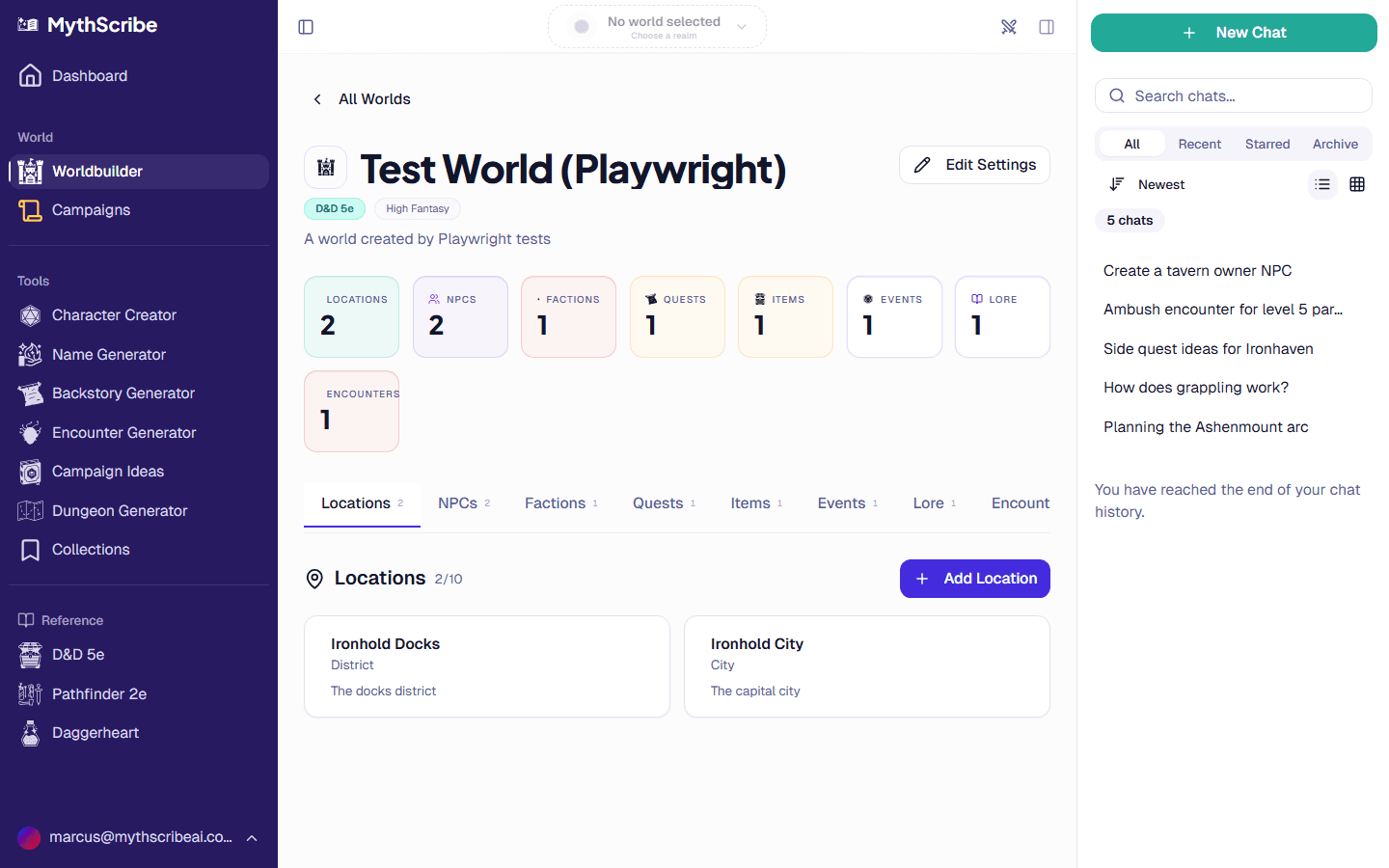 MythScribe worldbuilder showing NPCs, locations, and campaign notes
With a worldbuilder like MythScribe's, you can search any NPC you created in session 1, see what you said about them, and pull that into new content without re-reading pages of notes. For professional DMs managing multiple campaigns, this is the difference between sustainable prep and burnout.
How AI Tools Change the Prep Math
The biggest obstacle to scaling professional DM work is prep time. If every paid session requires 2-3 hours of manual prep, your hourly rate is much lower than it appears. A 3-hour session at $60 that required 3 hours of prep is actually $10/hour.
AI tools change this math significantly. Here's what the prep workflow looks like with AI assistance:
Session planning (10-15 min instead of 60-90 min): Describe the situation at the end of last session, what the players are likely to pursue next, and the stakes involved. The AI campaign generator produces the session structure — key scenes, NPC motivations for this session, potential player choices, and contingencies.
NPC generation (2-3 min each instead of 10-15 min): Generate a full NPC with appearance, personality, motivation, secret, and sample dialogue. For paid campaigns, players expect named NPCs with depth — even minor ones. MythScribe's NPC generator produces complete stat blocks and personalities.
Encounter building (5 min instead of 20-30 min): Feed the context — location, story purpose, party level — and get a complete encounter with CR-balanced monsters, tactical notes, and environmental features.
Dungeon maps (2-3 min instead of 1-2 hours): If your session includes a dungeon, a dungeon generator with AI can produce a room-based map with hand-drawn styling. Export as PNG, import to your VTT.
For a professional DM running 3 sessions per week, reducing prep from 2.5 hours to 45 minutes per session saves 5+ hours weekly. That's time you can put into more sessions, better session quality, or simply not burning out.
What Makes a Professional DM Worth Paying For
Technical prep is the minimum. The reason clients pay a professional DM — and more importantly, return — is the experience at the table. A few things that separate professional-quality sessions from casual DM:
Consistent pacing. A paid session has a defined end time. Professional DMs end fights at natural pauses, skip over slow moments, and ensure the narrative moves. Clients who paid for 3 hours of play don't want 90 minutes of wandering.
Player agency that feels real. Paid sessions often have strangers at the table. Making each player's character feel important, even in a one-shot with no established relationships, is a skill that takes practice. Ask each player their character's goal for the session in the first 10 minutes.
Post-session notes. For multi-session campaigns, a brief recap sent after each session keeps clients engaged between games. It's also a retention tool — players who get a recap message feel like they're in a running story, not a game. Takes 10 minutes with AI.
No prep gaps at the table. Looking something up during play is fine. Visibly unsure what happens next is not. Having 2-3 prepared scenes for any direction the players go — even if they're sketched, not scripted — means you never stall.
Setting Up Your Professional DM Stack
If you're starting or professionalizing your DM practice, here's the minimal tool set:
- Virtual Tabletop: Foundry VTT (self-hosted, one-time purchase) or Roll20 (browser-based, subscription). Foundry has better automation; Roll20 has lower setup friction.
- Video: Discord with a camera, or Zoom for clients who aren't gamers. Camera is not optional — it builds presence and trust.
- Campaign management: A worldbuilder that keeps each campaign's state separate. MythScribe lets you create separate worlds per campaign with AI-generated content that stays in context.
- Scheduling: Calendly or a simple form for session booking. Eliminates the back-and-forth of scheduling across time zones.
- Payments: StartPlaying handles payments automatically. For direct clients, Stripe or PayPal.
You don't need all of this on day one. Start with Roll20 and StartPlaying. Add the rest as you scale.
FAQ
How much does a professional dungeon master make?
Part-time professional DMs running 3-5 sessions per week typically earn $500-$1,500/month at mid-range rates. Full-time DMs with established reputations and diverse income streams (sessions + content + corporate) can earn significantly more. It's a legitimate side income for most; a full-time career for a smaller number.
Do I need to be an expert to be a professional DM?
No — you need to be consistently good, not exceptional. Clients pay for a reliable, engaging experience, not a flawless mechanical performance. If you've been DMing for 2+ years and your groups enjoy your games, you have the foundation. The professional part is about reliability, communication, and client management as much as DM skill.
What systems do professional DMs usually run?
D&D 5e dominates the market — it's what most clients know and request. Pathfinder 2e has a smaller but dedicated audience. One-shot systems like Monster of the Week or Blades in the Dark work well for event DMs. If you want to maximize bookings, learn D&D 5e deeply before branching out.
Is there demand for professional DMs?
Yes, and it's growing. The TTRPG audience expanded significantly during 2020-2022 and has retained a substantial portion of those new players. Platforms like StartPlaying report consistent growth in session bookings year over year. The market exists; competition is increasing, but it's still early enough that quality DMs can build a following without a large existing audience.
How do I handle cancellations as a professional DM?
Set a cancellation policy before your first booking and state it clearly. Most professional DMs require 24-48 hours notice for a full refund, with partial or no refund for same-day cancellations. Enforce it. Clients who frequently cancel without notice will drain your time; a clear policy either trains them to respect your schedule or ends the relationship before it costs you.
Try These Tools Free
Put what you just read into practice.