Most D&D campaign ideas fail in the same place. The premise sounds great on the drive home, session one goes well, and by session six nobody can say what the campaign is about anymore. A good idea needs more than a cool image. It needs a conflict that keeps producing new problems after the party solves the first one.
Every idea below comes with four things: the premise, an opening hook you can run in the first scene, a villain or pressure that pushes back, and a note on why it lasts. They are written setting-neutral, so you can drop them into the Forgotten Realms, Golarion, the Daggerheart setting of your choice, or your own homebrew world.
If you want one built around your table instead of picking from a list, the Campaign Ideas generator takes your system, genre and level range and returns a premise, villain and quest hooks you can edit.
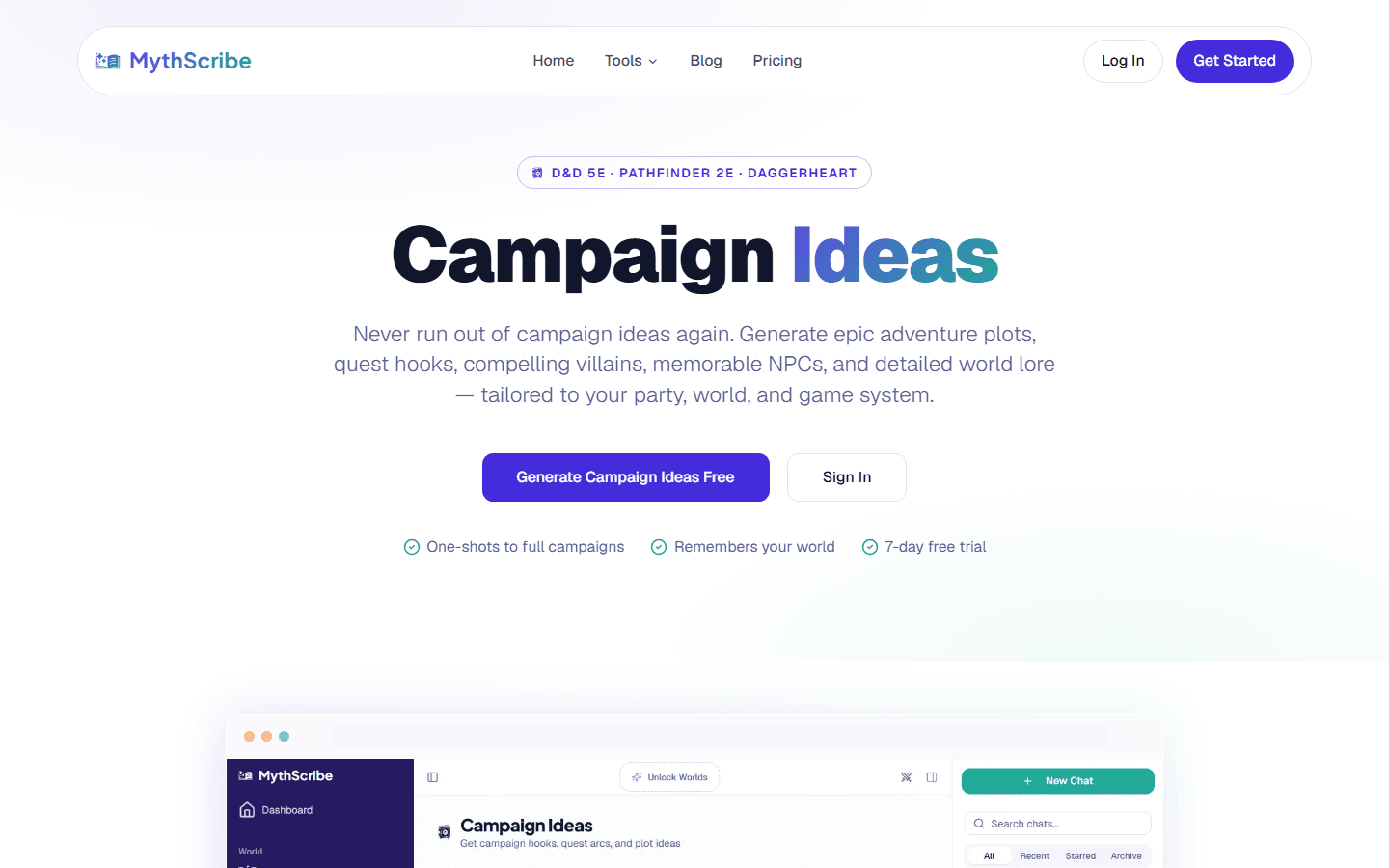 MythScribe's Campaign Ideas tool page, which builds campaign hooks for D&D 5e, Pathfinder 2e and Daggerheart
What Makes a D&D Campaign Idea Last?
Before the list, the filter. Every premise here passed these three checks:
- The conflict renews itself. Killing one cultist does not end a cult. A good campaign problem is a system (a war, a curse, a power vacuum) that keeps generating new trouble.
- The party has a reason to stay involved. Money works for a session. Personal stakes work for a year. Each idea gives you a way to tie the problem to the characters.
- There is room to move. The players need at least three directions to push in. A campaign with one road is a railroad, no matter how pretty the scenery.
High Fantasy Campaign Ideas
1. The Last Lighthouse
Premise: Magic in the world is fed by a chain of ancient lighthouses. One by one, their flames are going out, and the lands around each dark tower fall silent.
Opening hook: The party is in a coastal town when its lighthouse gutters. By morning, every spellcaster in town has lost their magic.
Villain: A grieving archmage who believes the lighthouses are a cage, and that dousing them will free something she lost.
Why it lasts: Each lighthouse is its own region, faction and dungeon. The party can travel in any order, and the villain's argument gets more convincing the more they learn.
2. Heirs of the Broken Crown
Premise: The old king died without an heir. Six claimants each hold a shard of the crown, and the crown only works when made whole.
Opening hook: A dying courier hands the party a shard and the name of the person it was meant for.
Villain: Whichever claimant your players dislike most. Let them pick their enemy through play.
Why it lasts: Six claimants means six factions with competing offers. Alliances shift, and the party's choices decide who rules.
3. The Dragon's Debt
Premise: A town made a bargain with a dragon two hundred years ago. The dragon has come to collect, and nobody alive remembers what was promised.
Opening hook: The dragon lands in the market square, politely asks for the mayor, and gives the town thirty days.
Villain: The dragon is not the villain. The family who altered the town records to hide what the original bargain cost is.
Why it lasts: It starts as an investigation, becomes a political fight, and ends with a choice about whether to honor or break an old promise.
4. The Sky Is Falling
Premise: Floating islands have hung above the world for millennia. Now they are sinking, slowly, and each one carries a city.
Opening hook: The party is hired to evacuate a farming village before an island lands on it. The island arrives a week early.
Villain: A guild of engineers who know why the islands are falling and are selling seats on the ones that are not.
Why it lasts: A ticking clock with a map. Every island is a new location, and the party has to choose who gets saved.
Dark Fantasy and Horror Campaign Ideas
5. The Town That Forgets
Premise: Every seventh night, the people of Hollowmere forget the last week. Someone is using those lost days.
Opening hook: The party wakes up in the town inn with injuries they don't remember and a note in their own handwriting: "Don't trust the reeve."
Villain: A hag who trades in memories and has been running the town from inside its forgotten weeks.
Why it lasts: It's a mystery the players solve across resets, leaving clues for themselves. Works well as a 6 to 10 session arc before opening into a bigger world.
6. The Plague Saint
Premise: A healer is curing a plague with miracles, and the cured are slowly becoming something else.
Opening hook: One of the party's allies, or a player character's sibling, is among the first cured.
Villain: The healer, who sincerely believes she is saving people.
Why it lasts: The party has to decide when the cure becomes worse than the disease. That question gets harder as the saint gains followers.
7. Beneath the Orchard
Premise: A wealthy family's orchard grows the sweetest fruit in the kingdom. The trees are planted over a buried god, and the fruit is how it eats.
Opening hook: Workers at harvest festival start sleepwalking toward the orchard at night.
Villain: The family matriarch, who keeps the god fed so it stays asleep.
Why it lasts: A slow-burn horror campaign about a rotten bargain that keeps an entire region prosperous.
8. Graves That Won't Stay Shut
Premise: The dead are rising, but only the ones who were murdered. Each one wants justice before it will rest.
Opening hook: The party is hired to guard a cemetery. On the first night, a corpse climbs out and asks them to find its killer.
Villain: A judge who has been covering up murders for powerful families for thirty years.
Why it lasts: Each risen corpse is a self-contained mystery. Together they point to one conspiracy.
Political Intrigue Campaign Ideas
9. The Masquerade Season
Premise: For one season each year, the capital's nobles conduct all business in masks, and anything said behind a mask carries no legal weight.
Opening hook: The party is hired to escort a masked guest to the opening ball. By midnight, the guest is dead and the party is wearing the masks of the suspects.
Villain: A spymaster using the season to stage a coup.
Why it lasts: A social campaign with built-in rules the players can exploit. Ballroom scenes, secret meetings and blackmail.
10. The Merchant Republic
Premise: A city run by trade guilds is about to elect its next doge. Votes are bought openly. The party has been given a vote.
Opening hook: Four guilds approach the party in the first scene, each with a bribe and a threat.
Villain: A guild leader planning to sell the city to a foreign empire after winning.
Why it lasts: The election is the first arc. Living with its result is the second.
11. The Hostage Prince
Premise: A peace treaty requires each kingdom to raise the other's heir. The party is the hostage prince's guard.
Opening hook: On arrival at the foreign court, the party learns the other kingdom's heir has already escaped.
Villain: A war party in both courts that wants the treaty to fail.
Why it lasts: Every session is a balancing act between protecting the prince and preventing a war.
12. Thieves' Guild Succession
Premise: The guildmaster of the city's underworld has vanished. Every lieutenant is making a move.
Opening hook: The party owes money to the guild, and their debt has just been inherited by the most dangerous lieutenant.
Villain: The guildmaster, who faked their disappearance to see who would betray them.
Why it lasts: A crime campaign with factions, heists and a debt that keeps the party in the game.
Exploration and Travel Campaign Ideas
13. The Map That Redraws Itself
Premise: The party finds a map that updates itself. Each morning, a new location appears on it that didn't exist the day before.
Opening hook: The first new location is the party's hometown, marked with a skull.
Villain: A cartographer-wizard who is rewriting the world one map at a time.
Why it lasts: A sandbox with a built-in reason to keep moving. You never run out of destinations.
14. The Caravan of Saints
Premise: A pilgrim caravan crosses a desert that changes shape every night. The party is hired as guards.
Opening hook: On the first night, the stars rearrange and the caravan's guide disappears.
Villain: Something walking alongside the caravan, wearing the faces of pilgrims it has already taken.
Why it lasts: A travel campaign where the caravan itself is the home base, with NPCs the party gets attached to.
15. The Drowned Kingdom
Premise: A kingdom sank into the sea three hundred years ago. A drought has just pulled the waterline back far enough to walk into its upper towers.
Opening hook: Treasure hunters are flooding into the exposed ruins. The party gets there first and finds a survivor who hasn't aged.
Villain: The drowned king, who wants his kingdom back above water and doesn't care what floods to make room.
Why it lasts: A megadungeon that gets deeper as the water recedes.
16. Frontier Charter
Premise: The crown grants the party a charter to settle a wild valley. They own whatever they can hold.
Opening hook: They arrive to find the valley already has residents, and a rival charter for the same land.
Villain: The rival charter holder, backed by a noble who wants the valley's silver mine.
Why it lasts: A base-building campaign. The settlement grows between sessions and gives players something to protect.
War Campaign Ideas
17. The Siege of Saltmarch
Premise: A fortress city is under siege. The party is inside.
Opening hook: The siege begins mid-session. The gates close and the party is trapped.
Villain: The general outside, and the traitor inside who opened a postern gate on night one.
Why it lasts: Every session is a mission: sabotage the siege engines, smuggle food, find the traitor. The pressure never drops.
18. Deserters
Premise: The party are soldiers who walked away from a war after being ordered to do something unforgivable.
Opening hook: The first scene is the order. The players decide whether to follow it.
Villain: Their former commander, now hunting them.
Why it lasts: A chase campaign with a moral core. Both sides of the war want the party for different reasons.
19. The Ten-Year War Ends Tomorrow
Premise: A peace treaty will be signed at dawn. Dozens of groups need it to fail before then.
Opening hook: The party is hired as neutral escorts for the treaty itself.
Villain: An arms merchant who has supplied both sides for a decade.
Why it lasts: It can be one tense session or a full campaign that follows the fallout of a fragile peace.
Weird and High-Concept Campaign Ideas
20. The Afterlife Is Full
Premise: The realm of the dead has stopped accepting new souls. Ghosts are piling up in the living world.
Opening hook: A party member dies in session one and doesn't leave. They are now a ghost with full powers.
Villain: The god of death, who has gone missing.
Why it lasts: Planar travel with personal stakes. The party is literally carrying a dead friend around.
21. The Wizard's Apprentices
Premise: The party are apprentices to a great wizard who has been turned into a cat.
Opening hook: The cat wakes them at dawn and explains, through a talking-familiar translator, that they have one month to find a cure.
Villain: The rival wizard who cursed him and wants his tower.
Why it lasts: Light-hearted but expandable. Works well for new players and mixed-age tables.
22. Monster Hunters Guild
Premise: The party joins a licensed monster hunting company. Contracts are posted on a board, and the guild takes a cut.
Opening hook: Their first contract is a "simple" owlbear. It's a druid's transformed child.
Villain: The guild's founder, who is breeding monsters to keep the contracts coming.
Why it lasts: Episodic by design. Players pick contracts, and a larger mystery builds underneath.
23. The Inheritance
Premise: Each player character inherits one-fifth of an estranged relative's estate. The estate is a haunted manor, a debt, a ship, a title and a sealed vault.
Opening hook: The reading of the will. Nobody at the table knew the deceased was related to the others.
Villain: The relative, who isn't actually dead.
Why it lasts: Five assets means five storylines, and players have a reason to keep each one running.
24. Gods Wanted
Premise: The gods are gone. Their power is up for grabs, and mortals are starting to claim it.
Opening hook: A party member's cleric spells keep working after their god dies. Someone notices.
Villain: A mortal who has already claimed two divine domains and wants all of them.
Why it lasts: A levels 1 to 20 arc with a clear endgame. Players can aim for divinity themselves.
How to Turn a Campaign Idea Into Session One
An idea is about 10% of a campaign. Here's how to get from premise to a playable first session in an evening:
- Write the opening scene first. Not the backstory of the world. The first five minutes at the table. Where are the characters, and what just went wrong?
- Name three factions. One that wants what the villain wants, one that opposes it, and one that wants to profit either way.
- Make five named NPCs. Give each a want and a single memorable detail. See our NPC ideas guide for prompts.
- Plan two scenes past the hook. You don't need more than that. Players will take session two somewhere you didn't plan.
- Tie it to the characters. Ask each player one question about how their character connects to the premise. Use their answers.
You can do all of this on paper. If you'd rather start from a draft, the Campaign Ideas generator builds the premise, villain and hooks, then you edit them into something that feels like yours. It supports D&D 5e, Pathfinder 2e and Daggerheart, and saves what you keep.
Example: a campaign generated with MythScribe
We set the generator to D&D 5e, Dark Fantasy, levels 1 to 4, and pressed generate once. Here is the opening of what came back, unedited:
Campaign Title: The Whispering Blight of Oakhaven
Quest Hook: The vibrant autumnal hues of Oakhaven have begun to wither into a sickly, unnatural grey. Animals in the surrounding woods are turning rabid and aggressive, and a chilling miasma seems to emanate from the deep woods, stealing the warmth and life from everything it touches.
Villain: Malakor the Shadow Weaver. Driven by a desperate and twisted desire to reclaim his lost life and power, Malakor seeks to drain the life force of the land and its inhabitants to fuel his dark resurrection.
The full result runs through three acts with named NPCs, first-session challenges (blighted fields, a silent forest, an abandoned watermill with ritual markings) and a sequel hook. The text sits in an editor, so you can rewrite anything before saving it.
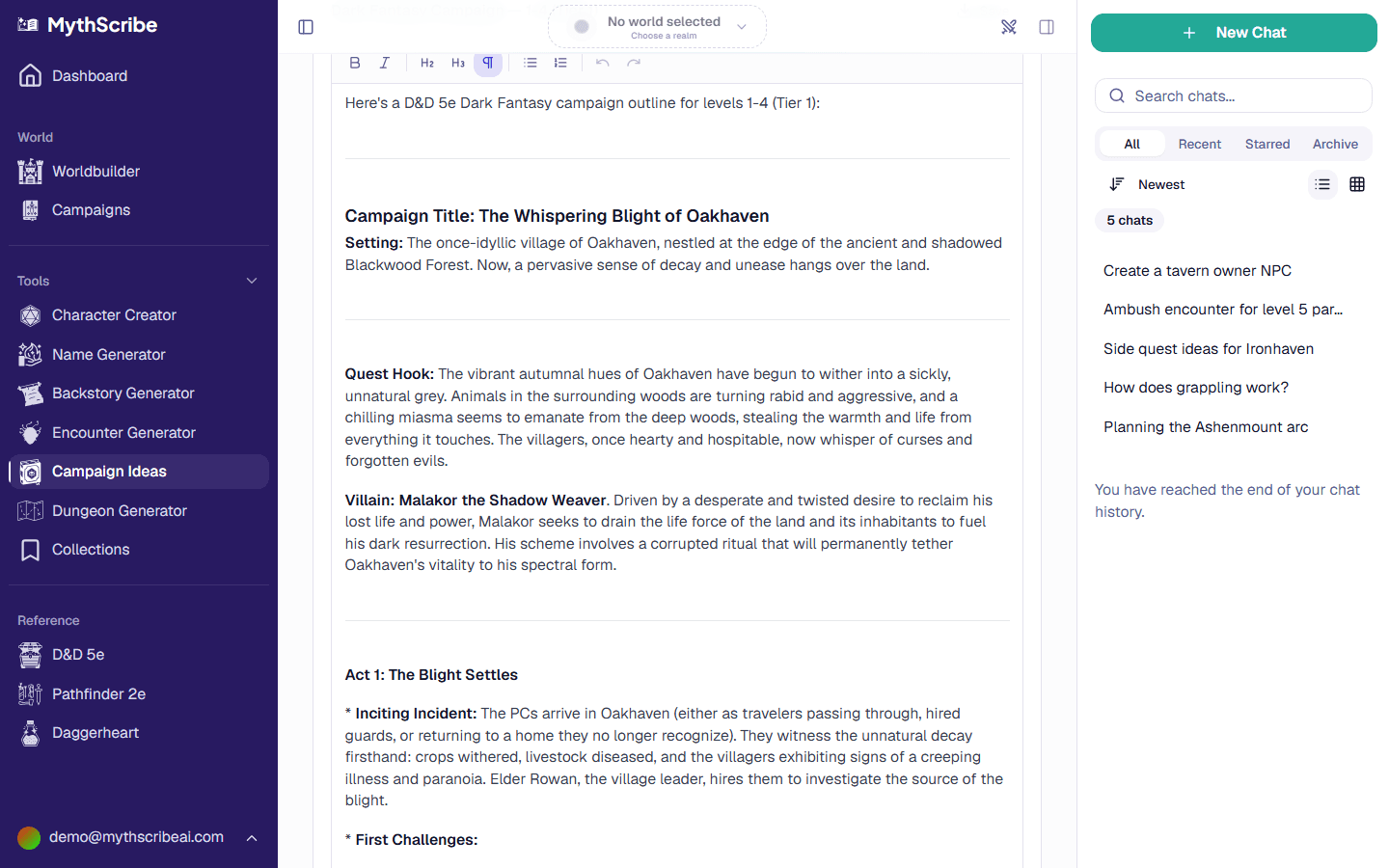 MythScribe Campaign Ideas result: "The Whispering Blight of Oakhaven", a D&D 5e dark fantasy campaign for levels 1 to 4
It's a draft, not a finished campaign. "Mysterious blight and a villain who wants to come back from the dead" is a familiar setup, and the result is better once you add a twist from the list above (try The Plague Saint's question of whether the cure is worse than the disease).
Keeping Track of Factions, Villains and Plot Threads
The point where most campaigns stall is around session eight, when the DM has forty pages of notes and can't remember which faction owes the party a favor. The fix is to store campaign facts in one place, with links between them. Our comparison of worldbuilding tools covers the options, from World Anvil to Obsidian.
In MythScribe's Worldbuilder, each faction, NPC, location and quest is its own entry. A faction card shows its type and the party's reputation with it, so you can see at a glance who is angry with the players.
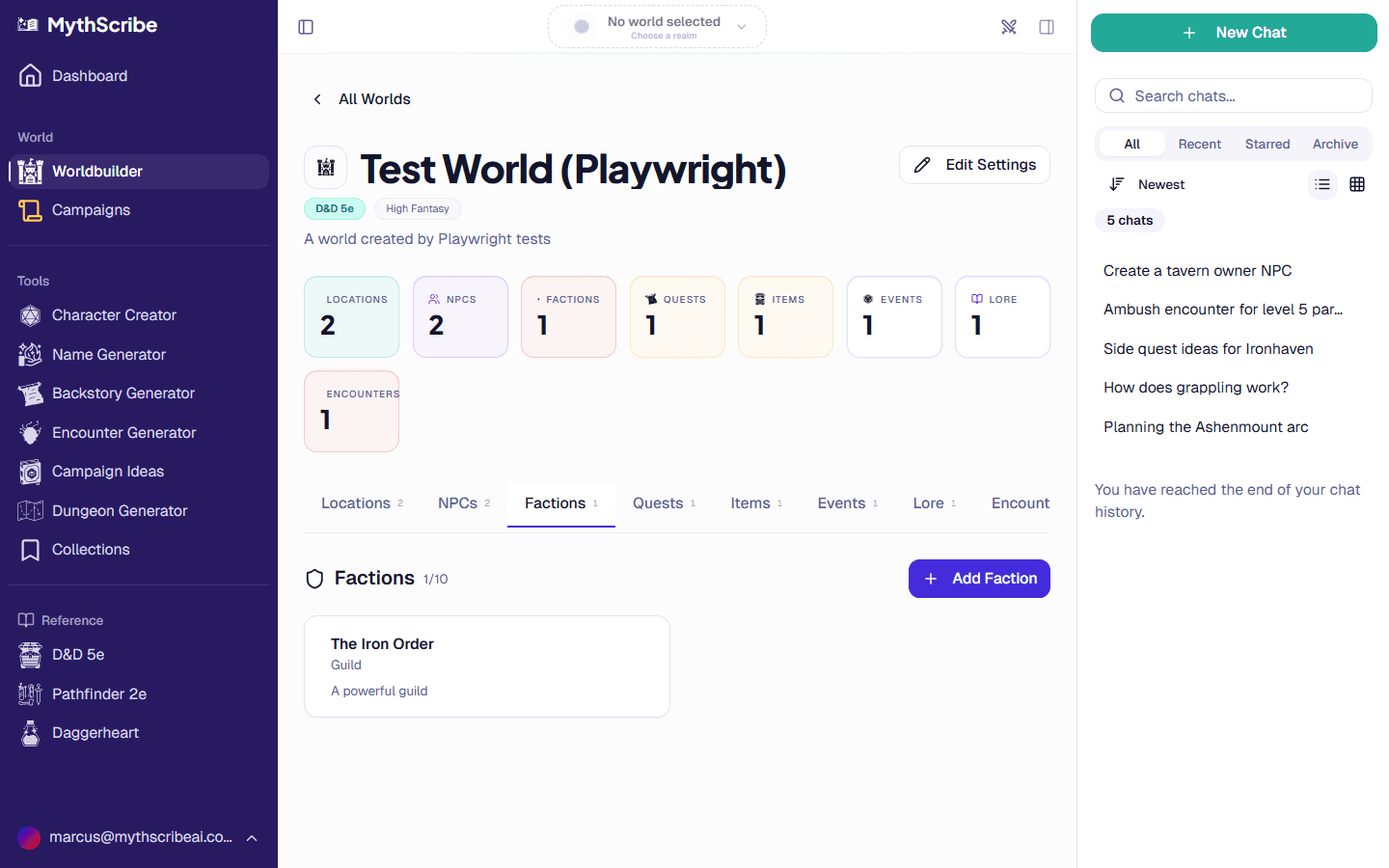 Worldbuilder factions tab showing the Ember Covenant at -40 reputation and the Iron Circle at 65
When you use the generators or the chat with a world selected, they read those entries. Ask for a quest hook, and it knows your villain's plan and which factions hate each other.
Adapting These Ideas for Pathfinder 2e and Daggerheart
None of these premises depend on D&D-specific rules, but a few tips help them land in other systems:
- Pathfinder 2e: The war and siege ideas (17, 18, 19) suit PF2e's tactical combat. Build encounters with PF2e's threat levels (trivial, low, moderate, severe, extreme) rather than converting 5e CR. Golarion already has nations at war if you want a ready-made backdrop.
- Daggerheart: The horror and intrigue ideas (5 through 12) fit Daggerheart's narrative focus. Fear gives the GM a resource to spend when things go wrong. Use the class background questions to tie each character to the premise in session zero.
- Any system: The Inheritance (23) and Monster Hunters Guild (22) are the easiest to drop into any game, because the structure carries the campaign, not the rules.
Our Pathfinder vs D&D and Daggerheart vs D&D comparisons cover the bigger differences if you're choosing a system.
Frequently Asked Questions
What is a good first D&D campaign idea for new players?
Pick something with a clear goal and a home base. The Wizard's Apprentices (21), Monster Hunters Guild (22) and Frontier Charter (16) all give new players an obvious next step each session, which matters more than an elaborate plot.
How long should a D&D campaign be?
As long as your group will actually finish. Many groups do better with a 6 to 12 session arc than an open-ended campaign. Several ideas above, like The Town That Forgets (5), work as a short arc that can open into something larger.
Where can I find more D&D campaign ideas?
Mix sources: published adventures for structure, history and myth for conflicts, and your players' backstories for personal stakes. Our guide on how to make a D&D campaign walks through building one from scratch, and the D&D one-shot ideas list has shorter premises you can expand.
Can I generate D&D campaign ideas automatically?
Yes. The Campaign Ideas generator creates a premise, villain, factions and quest hooks for D&D 5e, Pathfinder 2e or Daggerheart. Treat the result as a first draft and rewrite the parts that don't fit your table. You can start a 7-day free trial to try it with your own world.
Try These Tools Free
Put what you just read into practice.